

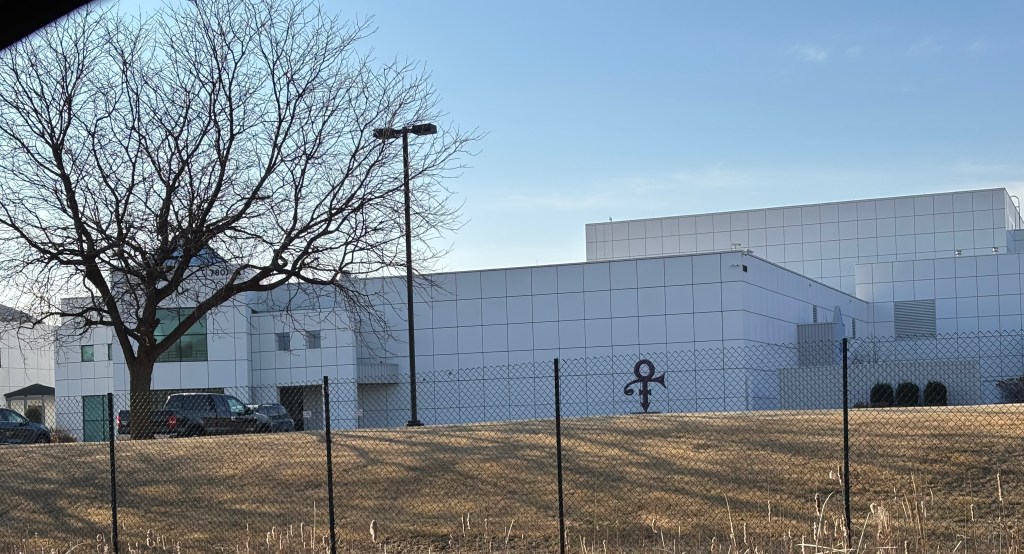
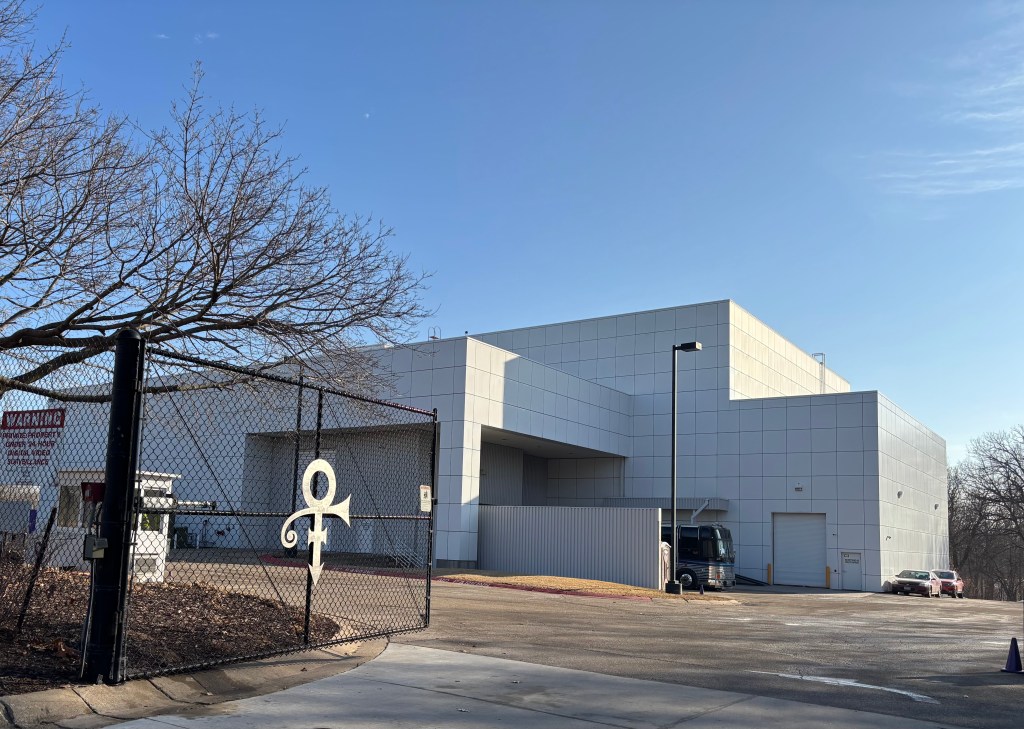
Kris and I began talking about Prince this morning. I wanted to make sure I remembered the “Purple Rain” story accurately, which she confirmed that I did. She and Jim both said, “You know, he is from right here.”, meaning the town they lived in. Apparently, that was one of the reasons Kris was so taken with Prince, he was really a home town hero. His house and land was 5 minutes from their house, and because he died without a will, the land was broken up and sold. There are now heaps of homes on that land. The Paisley Park Museum is also 5 minutes away. I did not go in, but I did take pictures from the road.

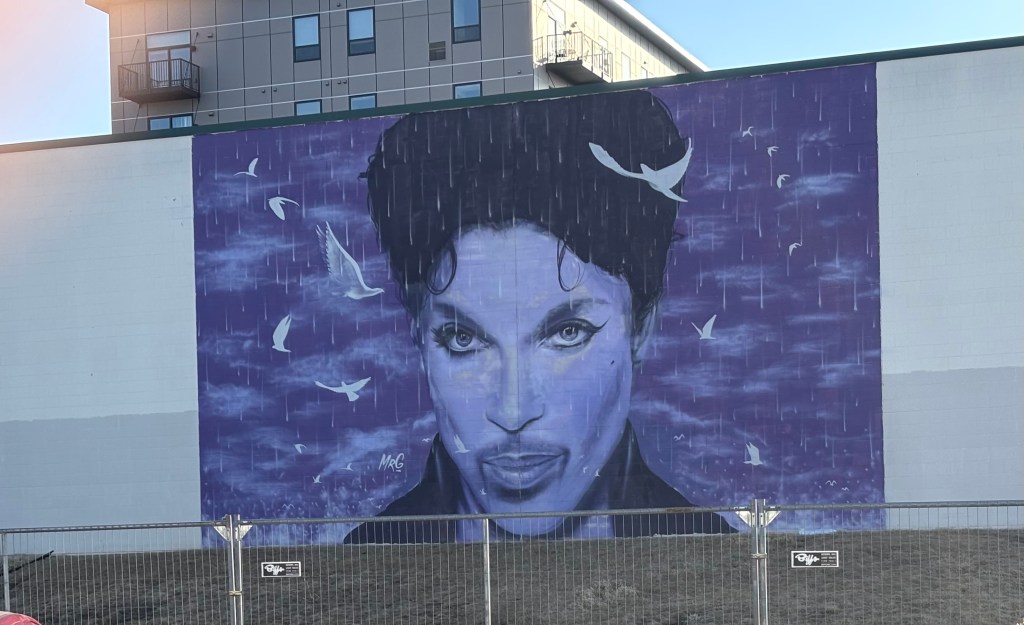
On the back of the Chanhassen Cinema is a mural of Prince painted by New Zealand artist, Graham Hoete, who is known as “ Mr. G”. He specializes in “spray paint photo realism”. It was painted in 2016, a few months after his death, and is beloved by the community. Prince loved films and often contacted the manager of the cinema to ask to see movies at odd times (like 1:00am), in order to enjoy them in private, without being hounded by the public. Mr G donated his time and skill to create the mural for free. The Cinema is being torn down and the community is upset at the loss of the mural. Three weeks ago, Mr G announced on his Facebook page that he was approached to create a new mural in Chanhassen and it has been confirmed that he will paint it in 2026.
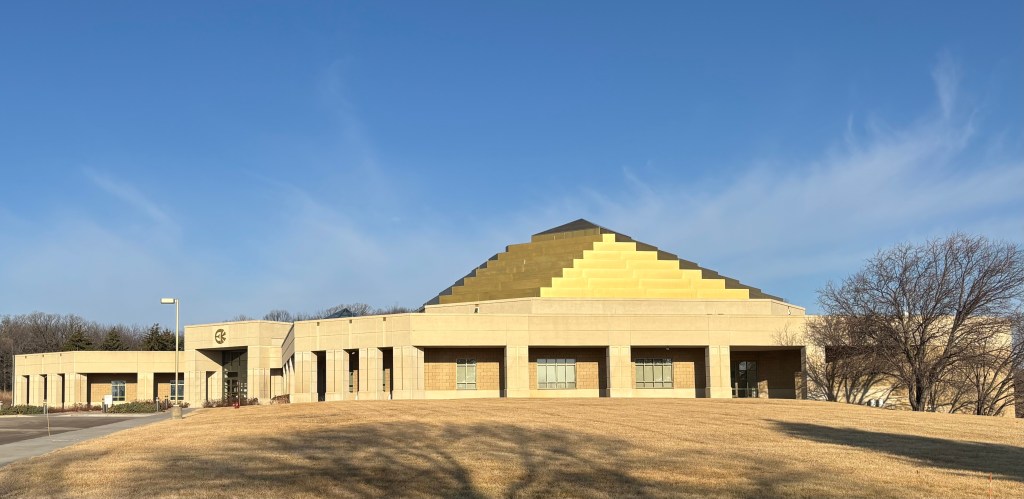
Having noted my posts about big unusual things, Kris asked if I had seen the Temple of ECK, also very close to their house. This is the spiritual headquarters of Eckankar, a spiritual and religious practice developed by Paul Twitchell in the 1960s. I will leave it to you to investigate this more if you choose.
After I saw these sites, I continued 6 1/2 hours southeastward to Chicago. I love the city of Chicago. I lived outside of Chicago as a child, Rod’s sister, Laura, and her family live there, Bridget grew up there, my daughter Kate and her husband Brendan live there, my son Patrick is often there performing with his band. My niece, Molly, attends school in the greater Chicago area. So many people I know have some connection to the city.
Chicago is the most populous city in Illinois with 2,638,159 people living within the city limits in July, 2024. The Chicago metro area has a population of nearly 9.5 million people. This explains why traffic is always terrible.
Some fun facts:
The city’s name is derived from a French rendering(“Checagou”) of a Native American word from the Miami-Illinois nation which can mean “skunk” and “ramps”, a wild relative of onion and garlic.
Chicago has several nicknames- The Windy City, Chi-Town, Second City, and City of the Big Shoulders. I guess Skunky Garlic City never caught on.
Jean Baptiste Point du Sable established a settlement here in the 1780s. He is commonly known as the “Founder of Chicago”.
In 1871, the Great Chicago Fire (which may or may not have been started by Miss O’Leary’s cow) destroyed an area about 4 miles long and 1 mile wide and left over 100,00 people without their homes. During the rebuilding process, Chicago constructed the world’s first skyscraper in 1885.
Of the total population in 1900, more than 77% were either foreign-born or born in the US of foreign parentage.
During prohibition (1920-1933), gangsters and crime flourished. Al Capone, Dion O’Banion, Bugs Moran, and Tony Accardo battled the law and each other on the Chicago streets.
In 1974, the Sears Tower, the world’s tallest building at the time, was constructed in Chicago. It is now called the Willis Tower.
Richard M Daley, was elected mayor in 1989. He was Chicago’s longest- serving mayor, successfully running for re-election 5 times.
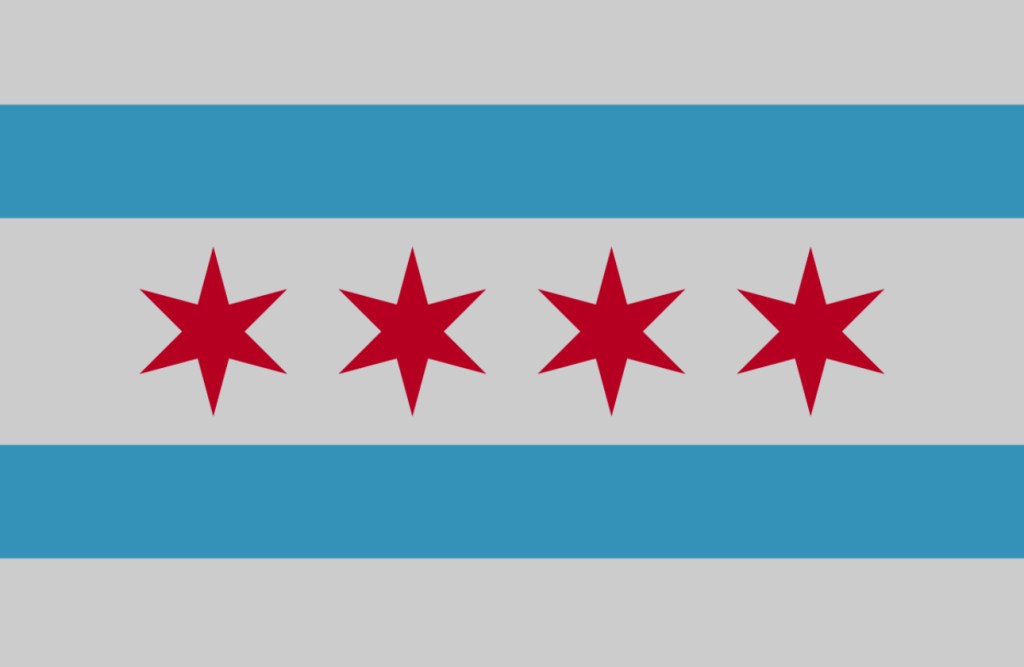
The Chicago Flag was designed but Wallace Rice in 1917 after winning a flag designing competition put on by the City Council. The three white bars on the Chicago flag represent the three sections of the city: the North, the West, and the South sides. The two blue bars represent water, Lake Michigan and the North branch of the Chicago River (the top bar), and the South branch and the Great Canal (the bottom bar). The four six pointed stars (they are six pointed because Rice, believed that five-pointed starts represented a sovereign state and this was just a city) each represent a major event in Chicago’s history. 1) Fort Dearborn, a US fort built in 1803 next to the river and destroyed in the War of 1812, 2) The Great Chicago Fire of 1871, 3) World’s Fair: Columbian Exposition, which took place in Jackson Park (the site of the current Museum of Science and Industry) in 1893*, and 4) Century of Progress Exposition in 1933. This second World’s Fair event celebrated Chicago’s centennial and focused on technological innovation. *This is also the setting for the 2003 historical non-fiction book by Erik Larson, The Devil in the White City, which I highly recommend.
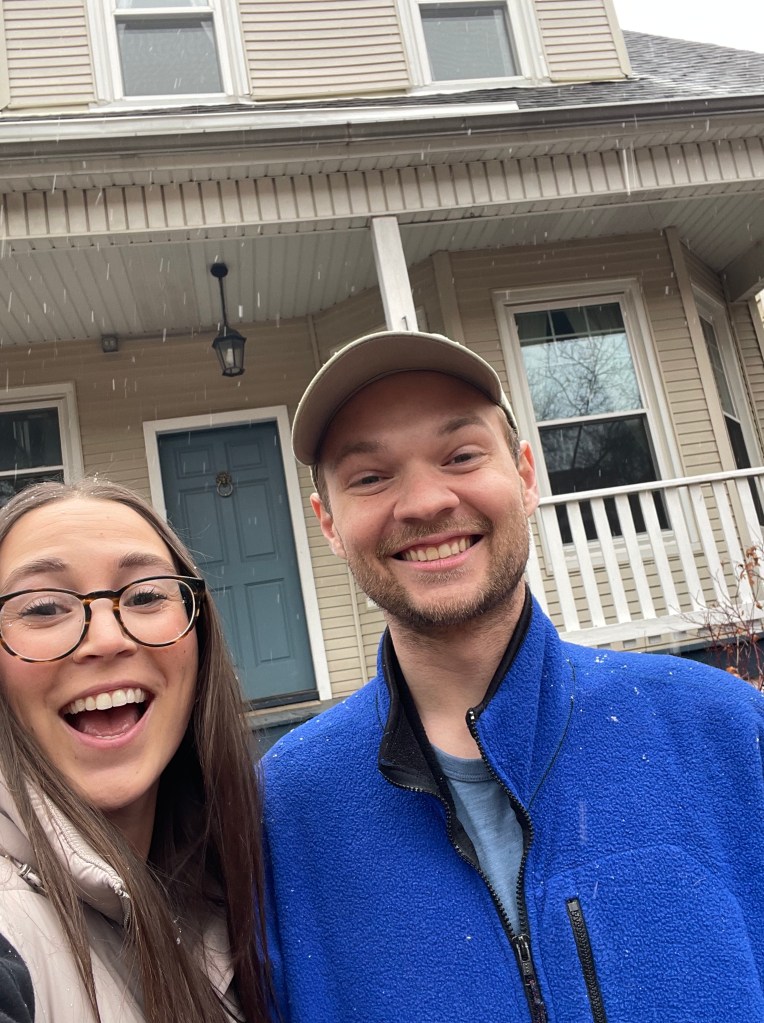
I had dinner with Kate and Brendan at their new house. They closed on it a week ago and have slowly been moving books and clothes to the house. It is a wonderful house, and I am thrilled for them to start this new, exciting chapter.
Good night Chicago, you Skunk Garlic City. I will visit the Art Institute and the Museum of Science and Industry tomorrow and then have dinner with Kate and Brendan after work. My trip is in the final stretch. It is lovely to end it here.
 What’s In Between
Leave a comment