“ The most important reason for going from one place to another is to see what’s in between…”. Horton Juster, The Phantom Tollbooth.
Why?
This is a question you may be asking. Why would I embark on a solo road trip between Cincinnati, New Mexico, Minnesota and back home? It’s not as if those destinations are close to each other. As a 61 year old women, is this really a good idea? Well, we are going to find out.
As a child, I spent a large portion of my life in the backseat of the family car on vacation. My father worked for Procter & Gamble and we moved from Seal Beach, California to St Louis to Chicago to Chesapeake, Virginia, to Lima, Ohio and then to Cincinnati. My parents loved to travel but with 3 children, and another to be born when we lived in Virginia, it would have been prohibitively expensive to fly everywhere. Plus flying was such a glamorous event back then, I don’t blame my parents for choosing a car trip over a flight where you needed to be dressed up and on your best behavior. So we drove and often camped while seeing parts of the United States. One summer it was New England, another out West, another the Midwest. Usually whatever was near by where we were living at the time. My mother was a history major so we spent one summer visiting Civil War battlefields (as an 11 year old, this was supremely boring as one field looked just like the next). Both sets of my grandparents lived in Arizona, and my cousins lived in California, so there were many road trips to visit them. I think I developed my love for reading during these trips in the back of the car. If I could get in the way back of the station wagon, that was the perfect spot. Old people will know what the way back was.
One of my favorite books in 4th grade (living in Chicago at the time), was The Phantom Tollbooth. For those unfamiliar, a young, bored boy named Milo is gifted a small tollbooth and he uses his little electric car to drive through it and to worlds beyond. The trip changes his outlook on life. As a child, I yearned to drive myself on a trip to unexplored places. Frankly, I was enamored with driving, hoping to become a bus driver when I grew up since I would be able to drive all day long.
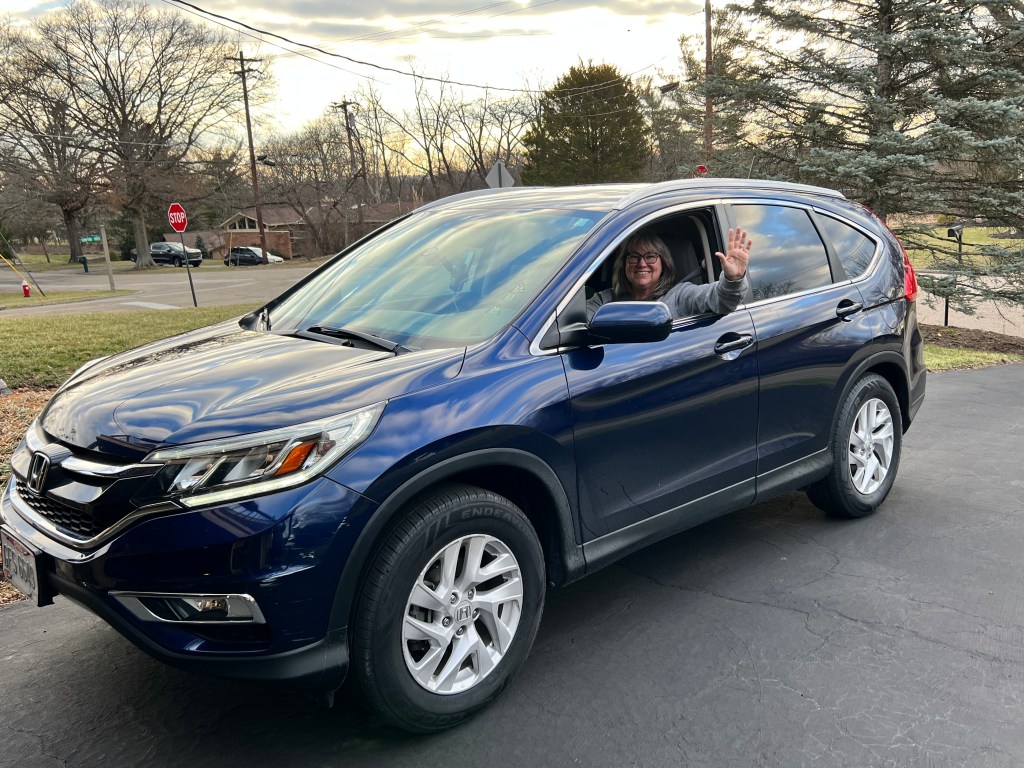
I have traveled to many places here in the US and around the world, and each trip has changed my outlook. But I have never traveled by myself. So on March 1, 2025, I will get in my little car, drive through my little tollbooth, and see what is in between here and there. If you would like to see what it is, please follow along.
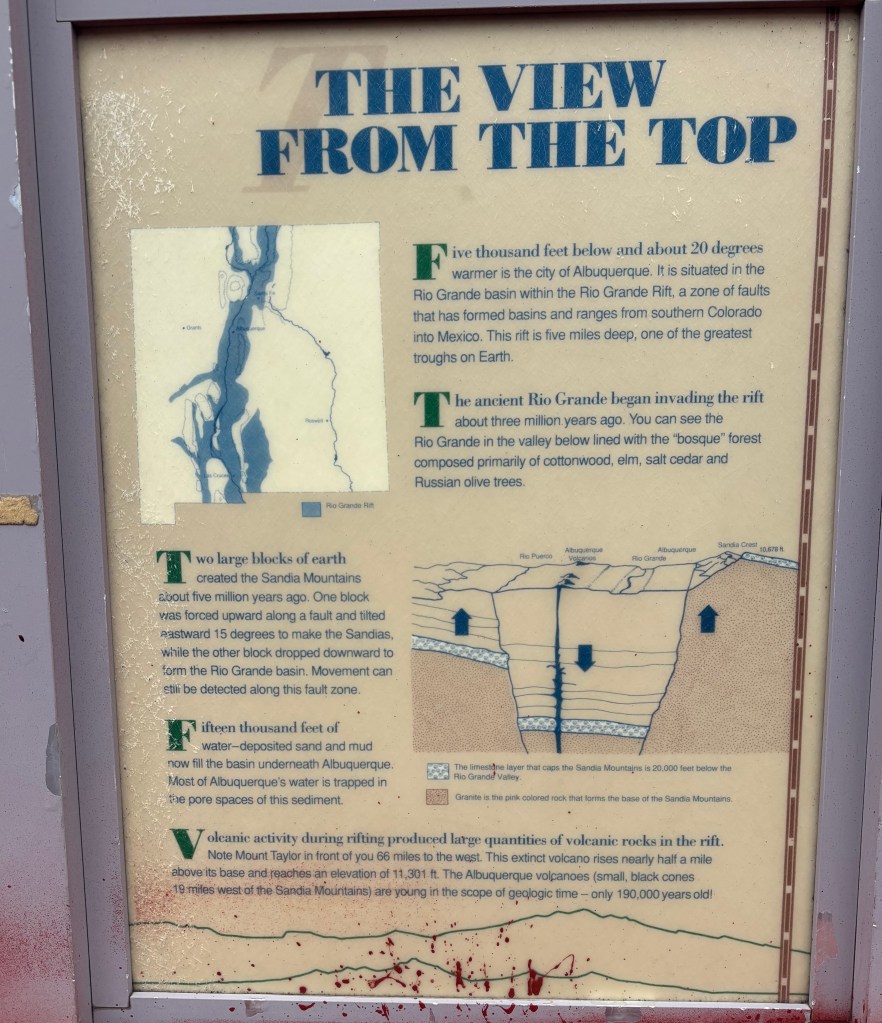
We packed up the cars and said goodbye to our Airbnb. 7404 Laster Ave NE was a lovely spot to spend two nights. Great location, locally owned and when there was one small mechanical issue, the owners father was there within 20 minutes to fix the issue. We headed to the Sandia Peak Aerial Tramway to take the 15 minutes tram ride to the crest of the Sandia Mountains. It is the longest aerial tram in the Americas and was the longest in the world from 1966 until it was surpassed in 2010 by the Wings of Tatev in Armenia.
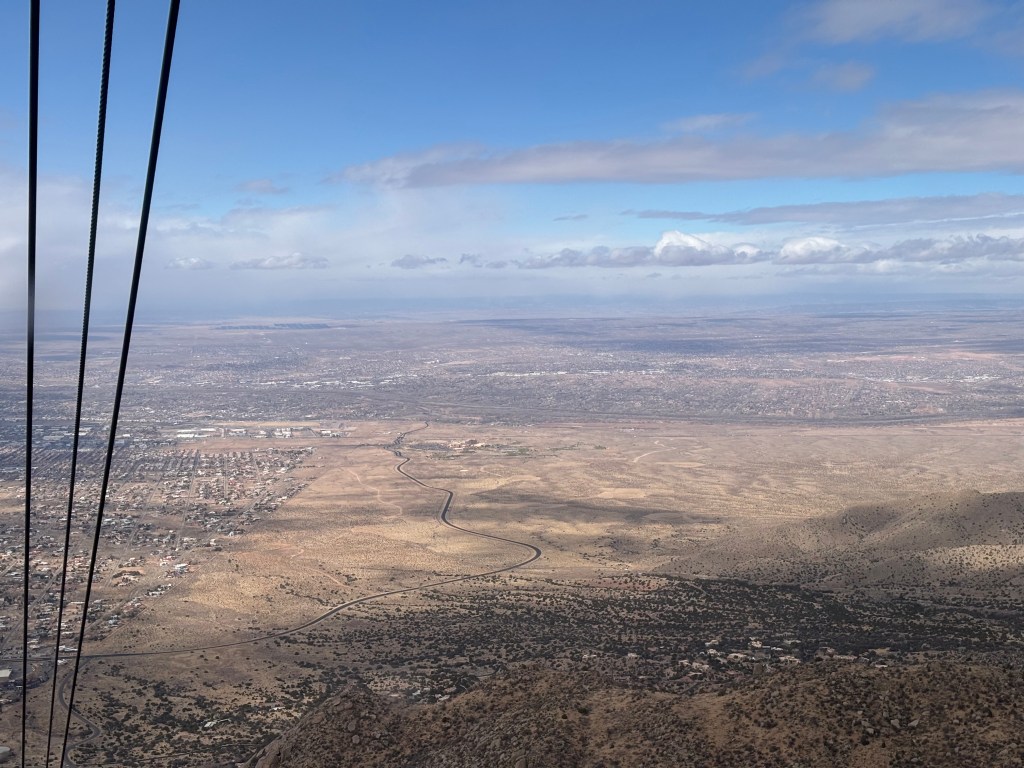
Albuquerque is New Mexico’s largest city with a population of 560,273 (2023). The entire state of New Mexico has a population of 2,130,256 (2024). This explained why there is so much seemingly unpopulated land out here.
This photo shows the demarcation between the city and Native American land. The winding road is on Native American land, while all the homes are on city land.
On our way to Moab, Utah, we stopped in the little town of Cuba to have lunch at the Cuban Cafe. Our servers daughter makes the tamales that the cafe serves so of course we had to order those. After we filled our stomachs, we filled the cars with gas and headed north.
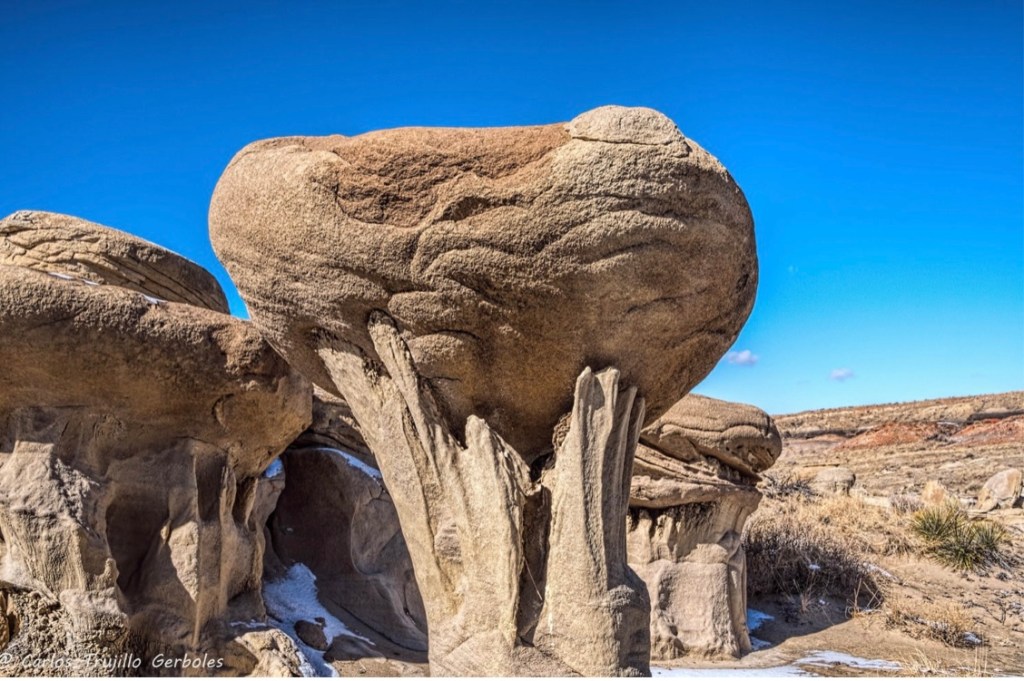
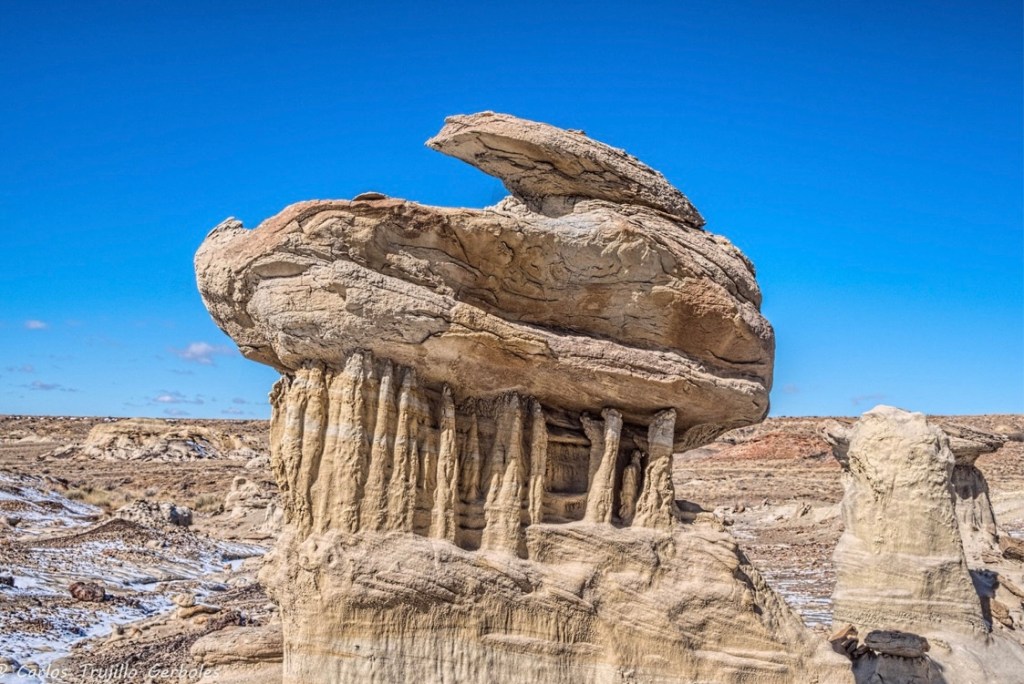
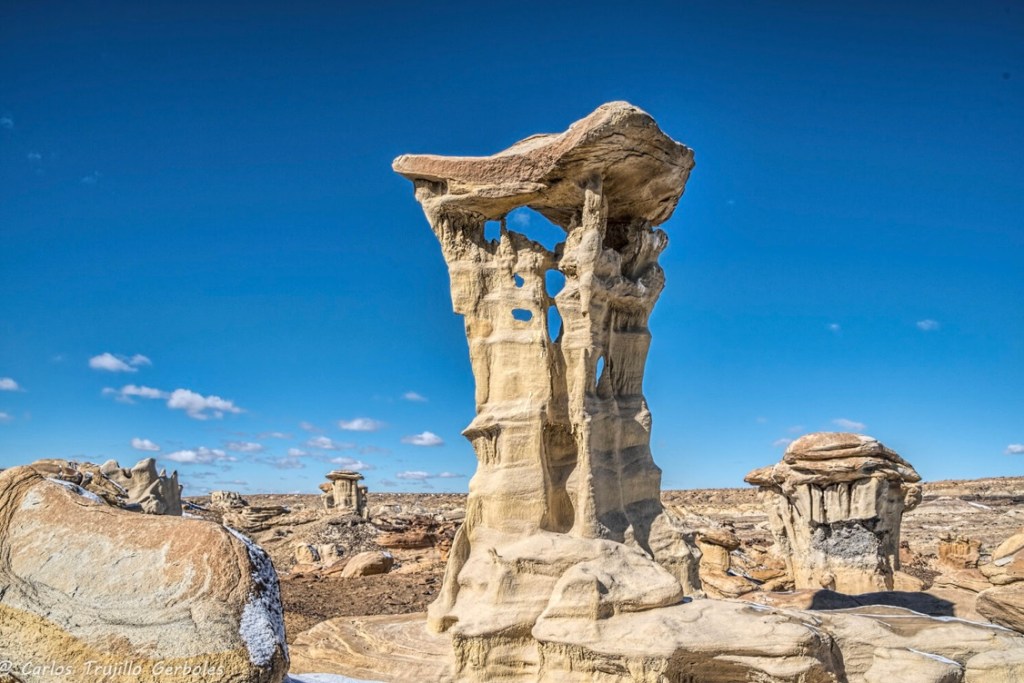
Beth had seen information about a secluded place called Valley of Dreams. It is between Cuba and Farmington, New Mexico, VERY off the beaten path. So much so that at one point, Google maps said it would take 1 hr 17 min, Apple Maps said, 1 hour 40 min, and maps.me said 2 hr 17 min. Each showed slightly different ways to get there. So we took a gamble and went with maps.me, because that is what Beth’s information said to use. Once we turned on to one of the recommended roads, the time went down to 18 minutes. We were overjoyed. This was short-lived. A winter storm, that we knew about but were hoping to beat, started right when the app said we were off the map. So we turned around and took the right where we took the left. We were still off the map. So we took the left again, the snow coming down harder and staring to stick (mind you we were on poorly paved roads with potholes and ruts) and we were magically back on the map, but our time to arrival was now 44 minutes. Afraid we would possibly 1. Get stuck in the snow, 2. Blow out a tire in the potholes, 3. Not see anything due to the snow even if we found it, we decided to abandon this little adventure. We drove 6 miles going 25 miles an hour to the highway and headed to Moab, again. This is what we were hoping to see.
Photo taken from internetPhoto taken from internetPhoto taken from internet
If it is a clear day, you have heaps of time, and you are between Cuba and Farmington New Mexico, I hope you can find it. It looks extraordinary.
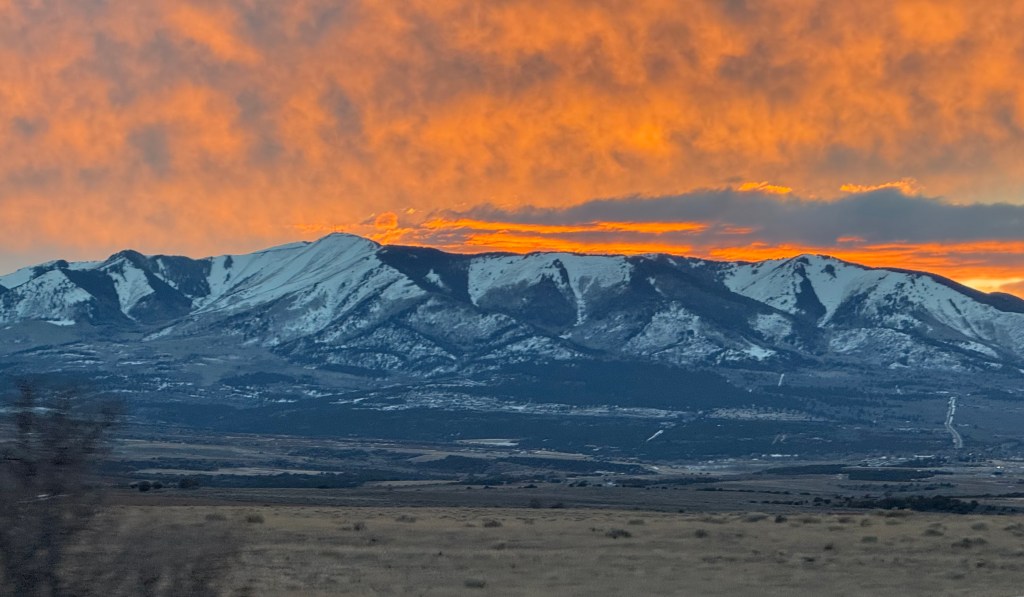
Back on the road, the snow stopped within 30 minutes and the drive was uneventful. Except for the sunset. There are not words to describe this beauty.
This is what it really looked like. No filters, no processing, taken out of the window of the rental car. Here is another from a different car:
This is through the windshield of my car. Again, no processing at all. Glorious!
We made it to Moab, hauled our stuff into the VRBO, and went in search of dinner. At Antica Forma, we ate salads and split a pizza between the 6 of us. And then we came home to bed. It was a long day, many hours of driving on the highway and off and we were ready to sleep. It was dark when we arrived in Moab. I have been to Moab and Arches National Park before. But no one else in the group has. I can’t wait to see their reaction when they see the landscape.
I woke up to a cloudy but dry day. After eating my third donut from the Donut Drive In, (not as good – donuts get stale after a while), I headed into Oklahoma City. It was rush hour and since everyone was speeding along, I decided to forgo audio and just drive in silence with my thoughts so as not to get distracted. Oklahoma had other plans. I was about a minute into the drive when I saw a giant (I mean ENORMOUS) sign off the interstate that said, “ RICK WARREN COURT CLERK”. It did not include the words Elect or Support. It also did not say Clerk of Courts which is the title I am used to for an elected official responsible for maintaining accurate court records and ensuring proper document filing. So my thoughts began to distract me. Is Rick running for election? Is he declaring he is a Court Clerk? Is he just reminding everyone? For which court does he clerk? Food court, tennis court, the court of public opinion? Why was Rick shouting this information at the public from the side of the interstate? By the time I reached my destination, I was no closer to the truth. Rick Warren, an Oklahoma City man of mystery. (As I sat down to write this post, I looked up Court Clerk. Court Clerk and Clerk of Courts are used interchangeably depending on the jurisdiction. He is a little less of a mystery, but not much).
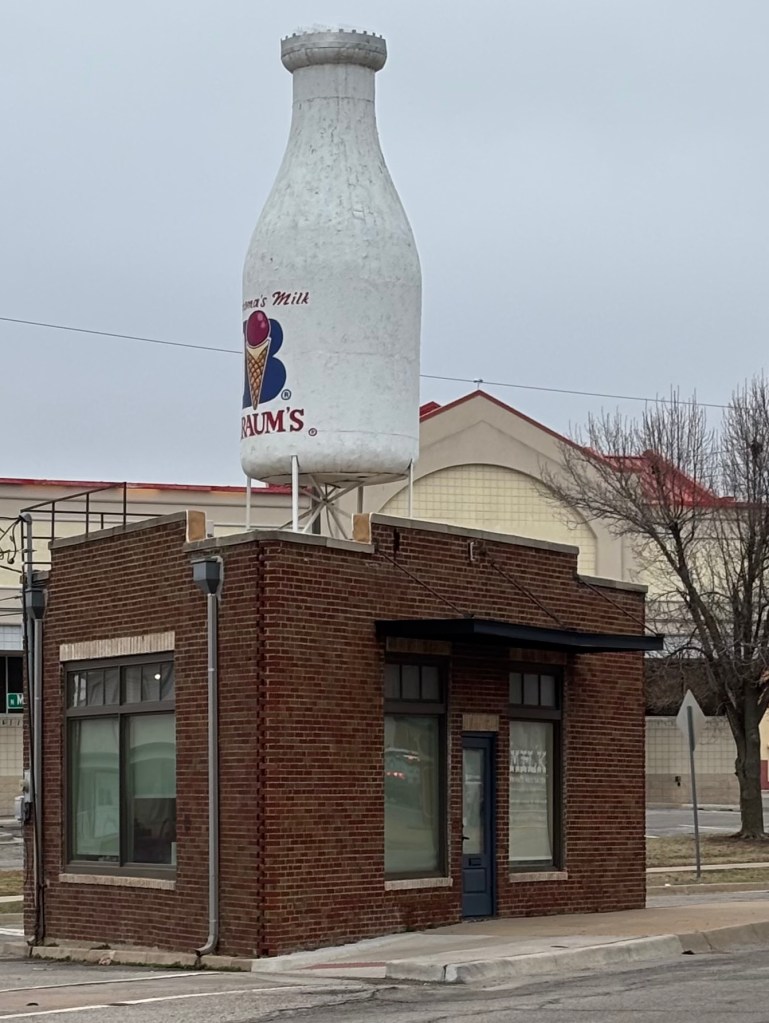
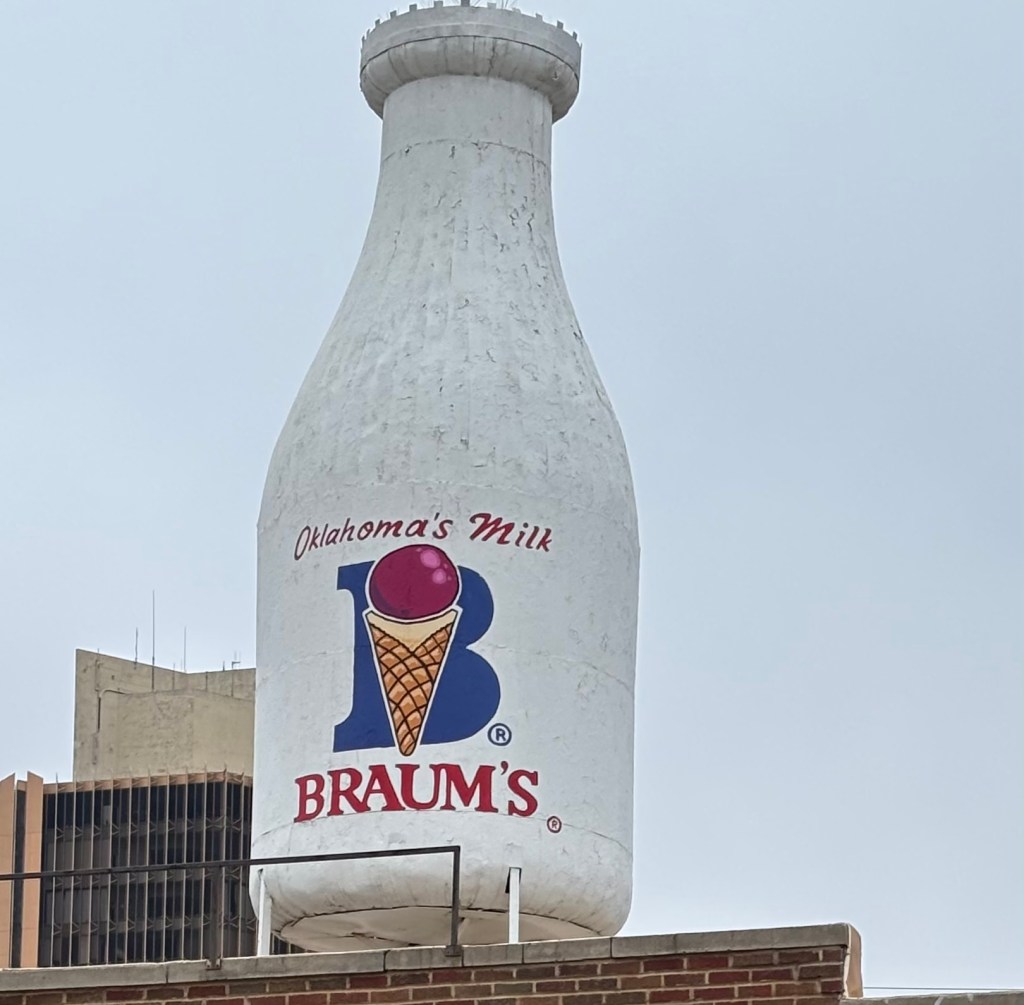
The Milk Bottle Grocery was a grocery store and ice cream chain constructed in 1930. The milk bottle, designed to draw attention to the store, was added in 1948. It is very small and right on the side of the street amidst large stores of all kinds as well as a modern Braums chain ice cream and hamburger restaurant down the block. I wish it was still a little ice cream place, instead it is a nail salon.
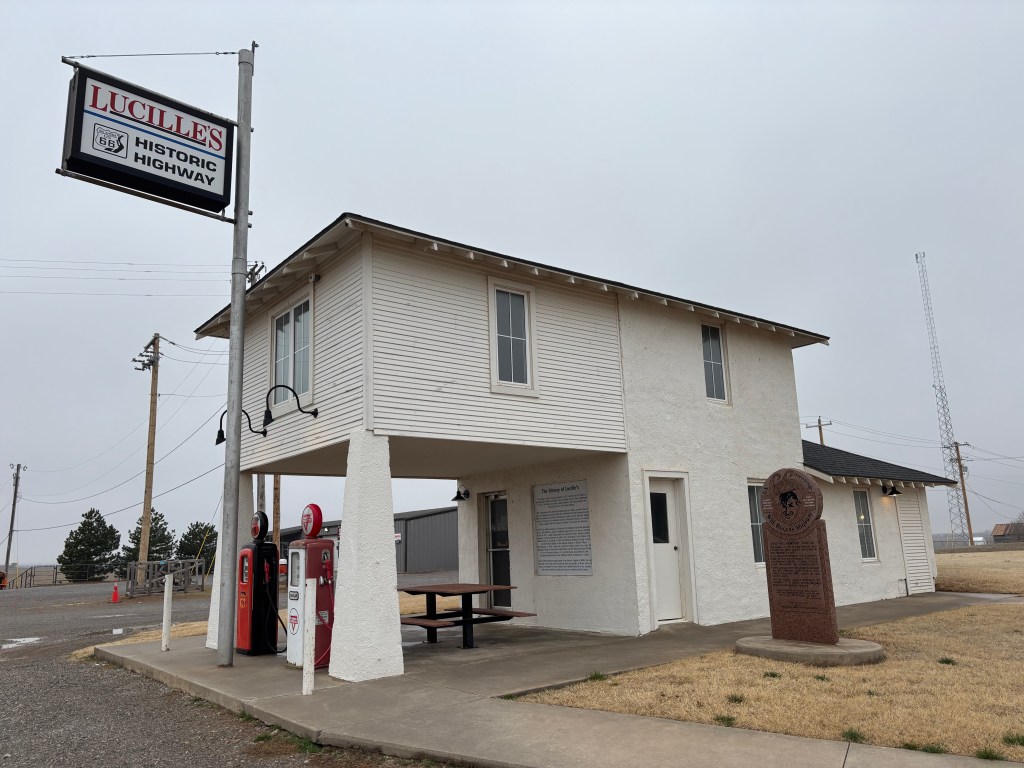
Lucille’s Gas Station was built in Hydro, OK in 1929 by Carl Ditmore. The service station was renamed the Provine Station in the 1930s. In 1941, Carl and Lucille Harmons purchased the station and renamed it Lucille’s. The family worked and lived in the same building, with the station in the front and the living quarters in the back and upstairs. In 1971, the completion of I-40 limited direct access to Rt 66 but Lucille kept the station running until her death in August, 2000. She passed away in her home, which was also her business along the shoulder of Route 66 for 59 years.
The last stop I made in Oklahoma was in the small town of Sayre. The Beckham County Courthouse was built in 1911 and is one of the few courthouses in Oklahoma topped by a large dome. The courthouse appeared in the film The Grapes of Wrath, a 1940 adaptation of the John Steinbeck novel. Families headed to California (such as the Joads in the film) passed through Sayre on Route 66, and many viewed the city as the start of the west.
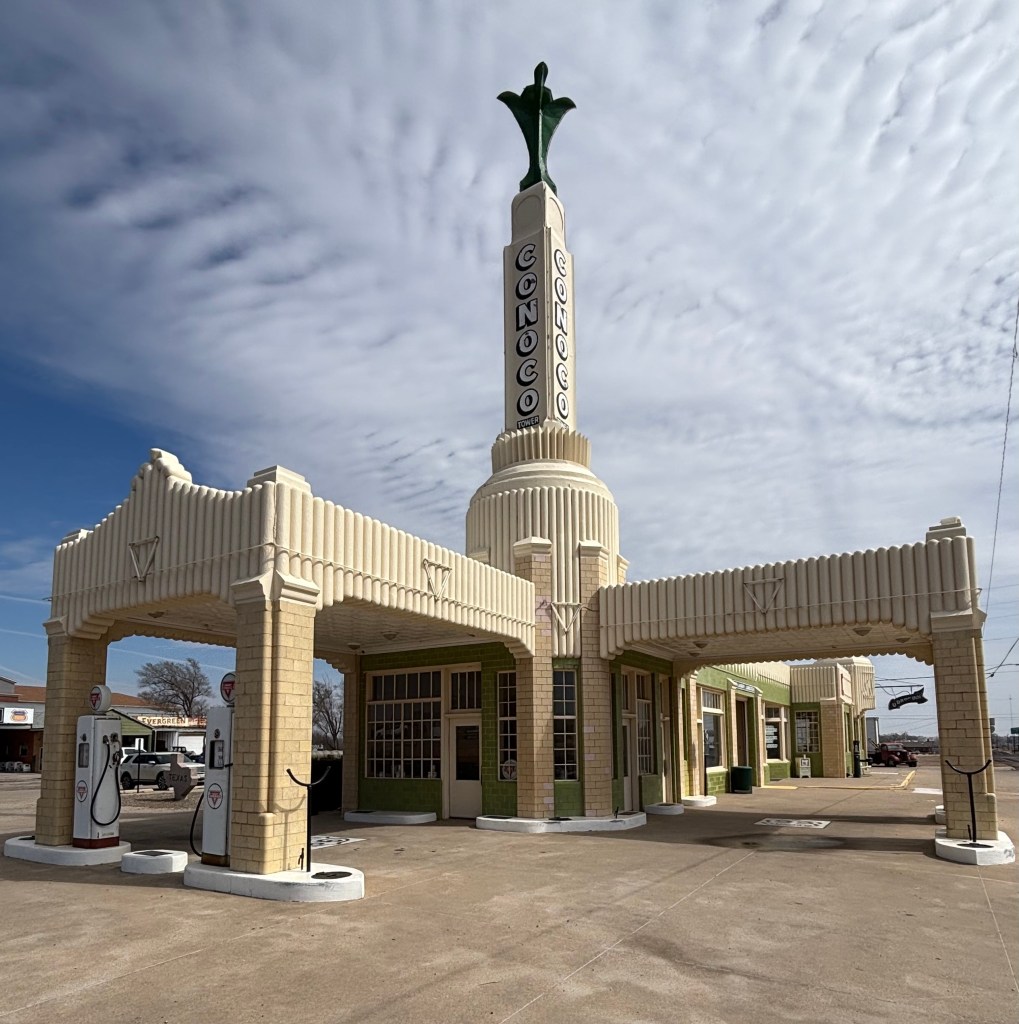
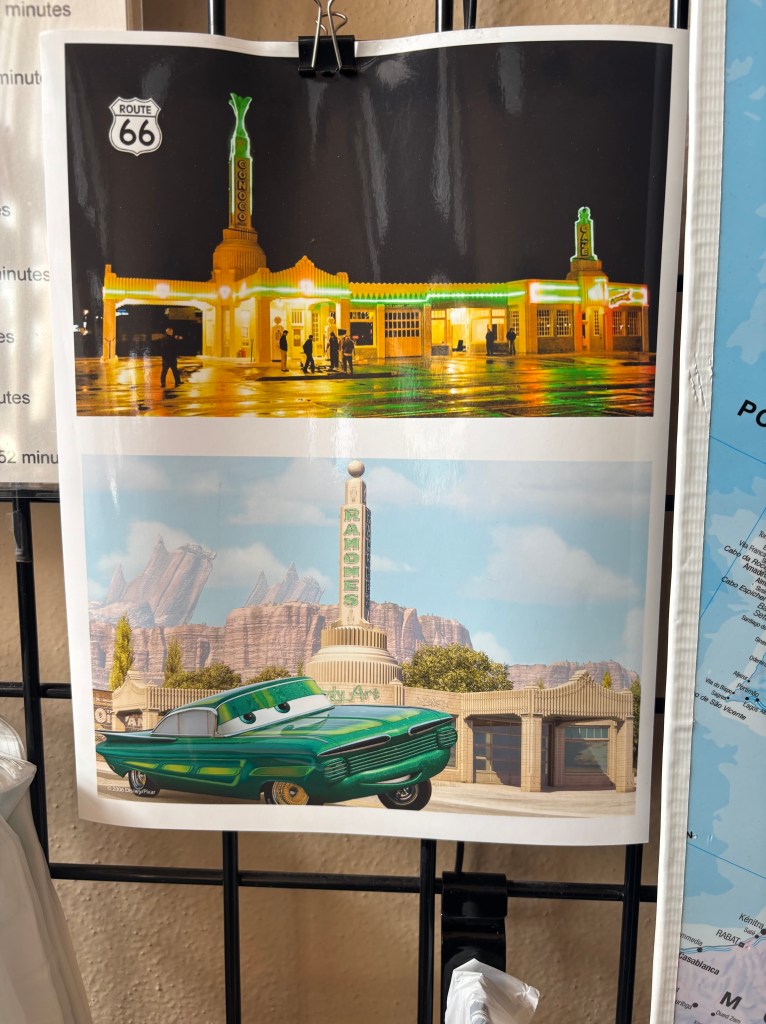
The next stop was my favorite of the day. I left Oklahoma and pointed the car toward Shamrock, Texas. I was headed to Tower Station & U-Drop Inn Cafe. The gas station restaurant was built in 1936 of brick and green glazed tile and represented the art-deco style that was popular in the 1920s and 1930s. J.M. Tindall and R.C Lewis constructed the tower and building at a cost of $23,000. There are conflicting stories about the design. One states that the design was originally drawn by John Nunn, a friend of Tindall, who picked up a nail and scratched out plans in the dirt. Another story says the unique building was designed by architect J.C. Berry of Pampa, Texas. He supposedly took inspiration from an image of a nail stuck in the soil. However it came about, the design is iconic and appears in the film “Cars” as Ramons Automotive Body and Paint Shop. If you haven’t seen the movie “Cars”, you really should. I will be rewatching it when I get home.
As I was taking pictures of Tower Station, a sweet older woman came out of the gift shop (located in the middle of the picture above) and started telling me about the building. She invited me into the shop and showed me the picture of the Tower Station & U-Drop Inn Cafe with its representation in “Cars”. I talked with her for a while and then headed into the U-Drop Inn Cafe for lunch. She gave me her lunch recommendation, the pulled pork sandwich, (which I had) and asked me how it was when I was finished. I told her it was delicious and she seemed so pleased. She also said, “The President seems to be making everybody mad but we will get through it. We always do.” This was completely unsolicited. It must have been on her mind. She could not have been sweeter or prouder of the Station.
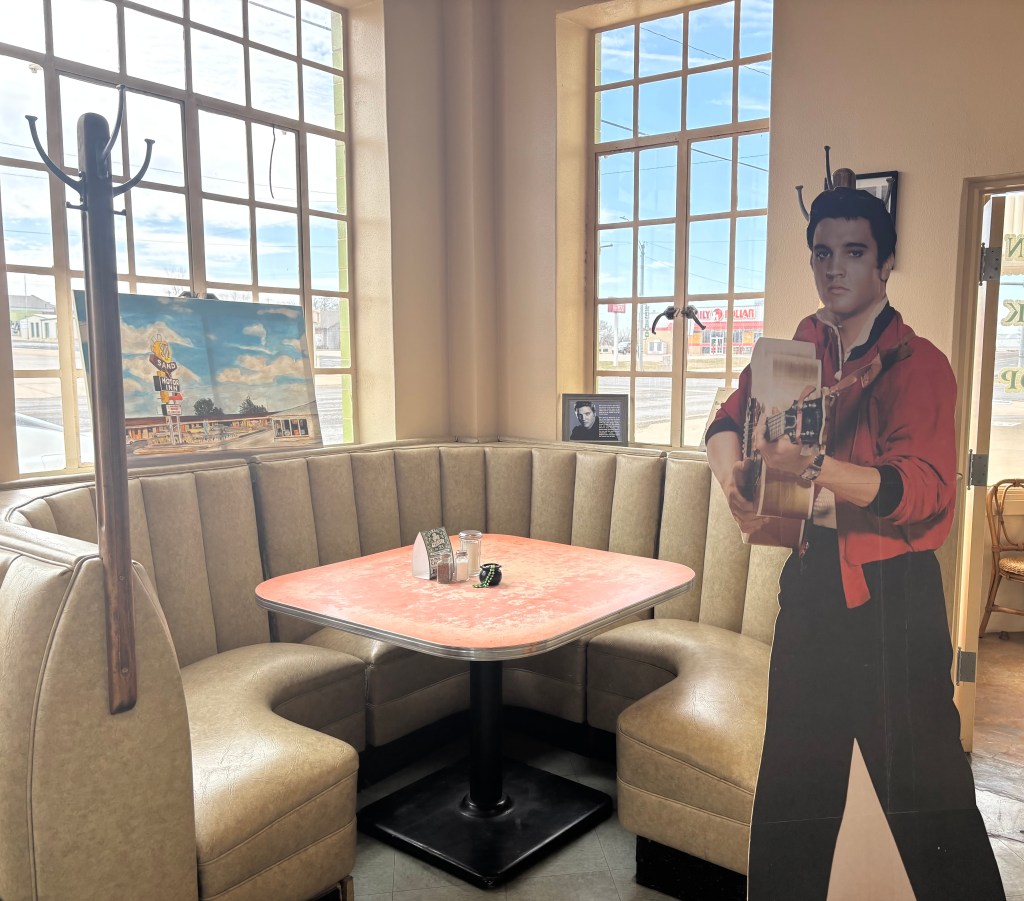
One of the U-Drop Inn Cafe’s most famous guests was Elvis Presley. There is a life size cut out of the King at the table where he ate. My mother’s younger sister, Suzi loved Elvis when she was growing up. My mother was not fond of Presley and used to tease Suzi by calling him “Elviris Peesly”. This drove Suzi crazy. Suzi got back at her by chasing her with worms. As I left the cafe, I gave Elviris a little smile, ready to move on to the next stop.
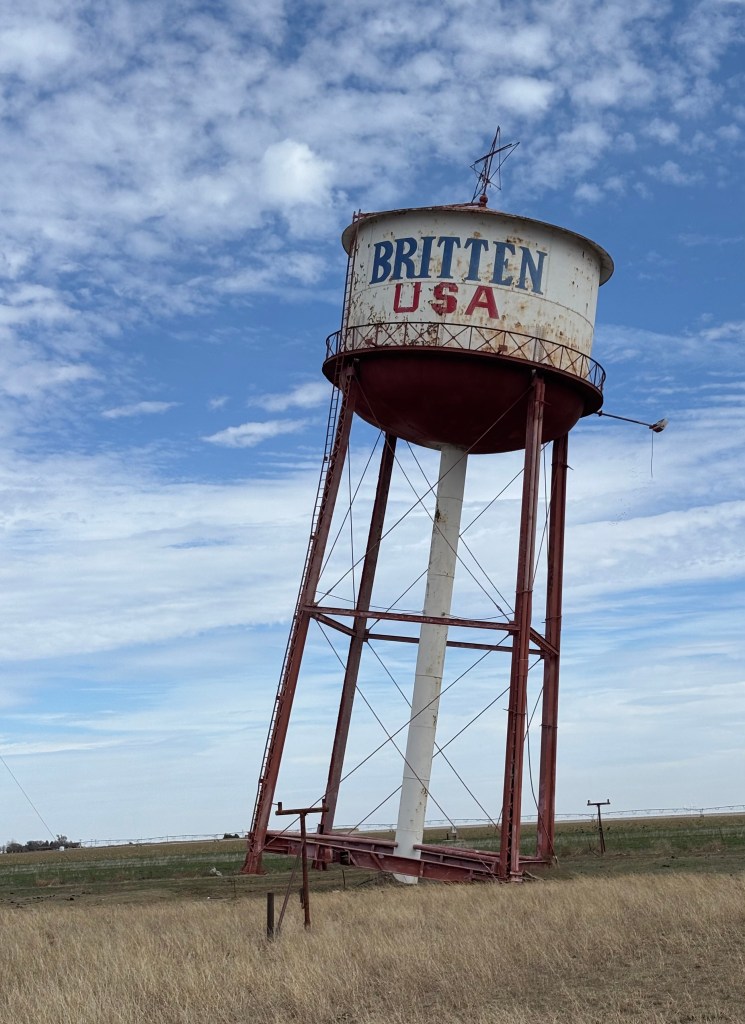
As I traveled on Rt 66 towards Groom, TX, I saw the Leaning Tower. There is no way you could miss it. Given the low vegetation of the Texas landscape, you can see it for quite a ways before you are upon it. Why is it leaning? It was not hit by a tornado, or shifted by an earthquake, but purposefully leaned as a marketing gimmick. Ralph Britten wanted to open a truck stop and restaurant off Rt 66 and he bought a water tower to attract new visitors. Using a bulldozer, he elevated two of the tower’s legs off the ground, dangling them in midair without support so the water tower tilted at an 80 degree angle. This trick helped his business tremendously. It caught the eye of every passing motorist for years, many terrified the tower was falling over. Unfortunately, Britten’s truck stop burnt down in a devastating fire in the mid 1980s. The leaning tower remains, part of the oddities of Route 66.
Amarillo, TX was my last stop of the day. As I was driving there, the winds began to pick up and tumbleweeds blew across the road. The winds got stronger and stronger and the tumbleweeds became more and more frequent. When I stopped to take a picture of the second to last thing I was to see, I was pelted with dust, tiny rocks, and tiny pieces of dried grass. I walked into a little shop to buy a can of spray paint and said to the cashier, “Man, it is windy out there”. She replied, “Yeah, this is spring in Texas”.
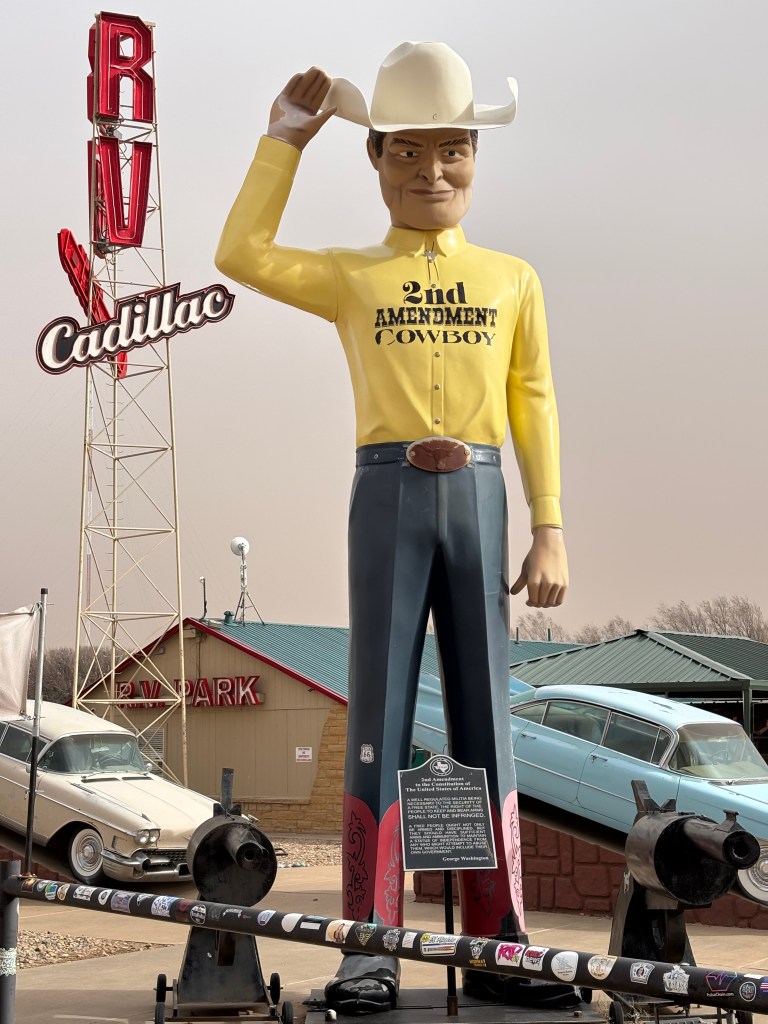
This second to the last thing was a giant cowboy. Created by Glenn Goode, this cowboy was positioned in front of a business in Sanger TX. Prior to his move to Amarillo in 2004, the cowboy was neglected and used for target practice (this is Texas remember) and that is where the nickname, “2nd Amendment Cowboy” comes from. Before the cowboy came to Amarillo, Goode repaired all the damage and restored him. And yes, those are two giant pistols at the cowboy’s feet.
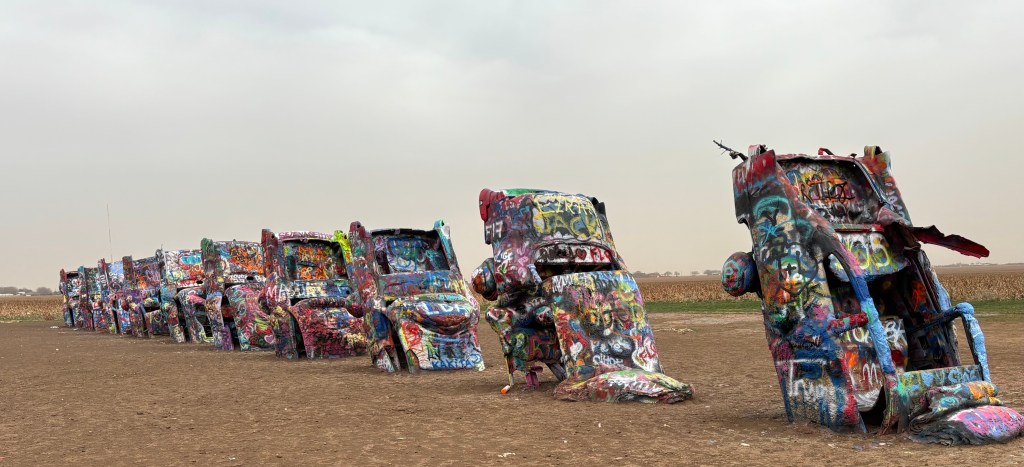
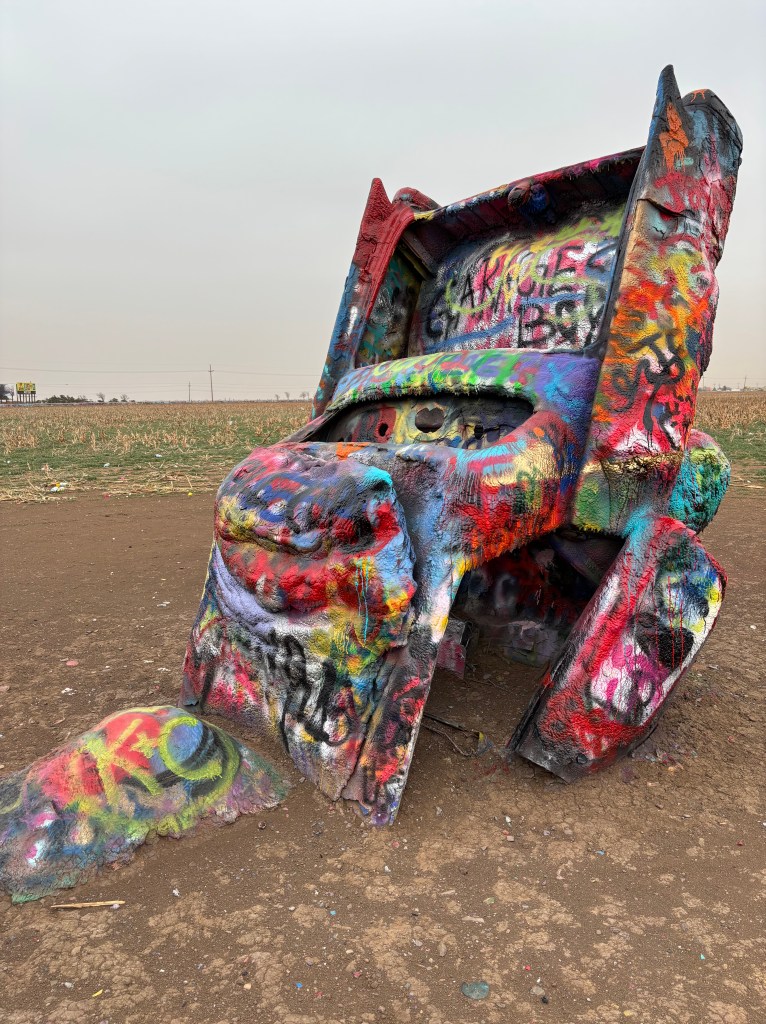
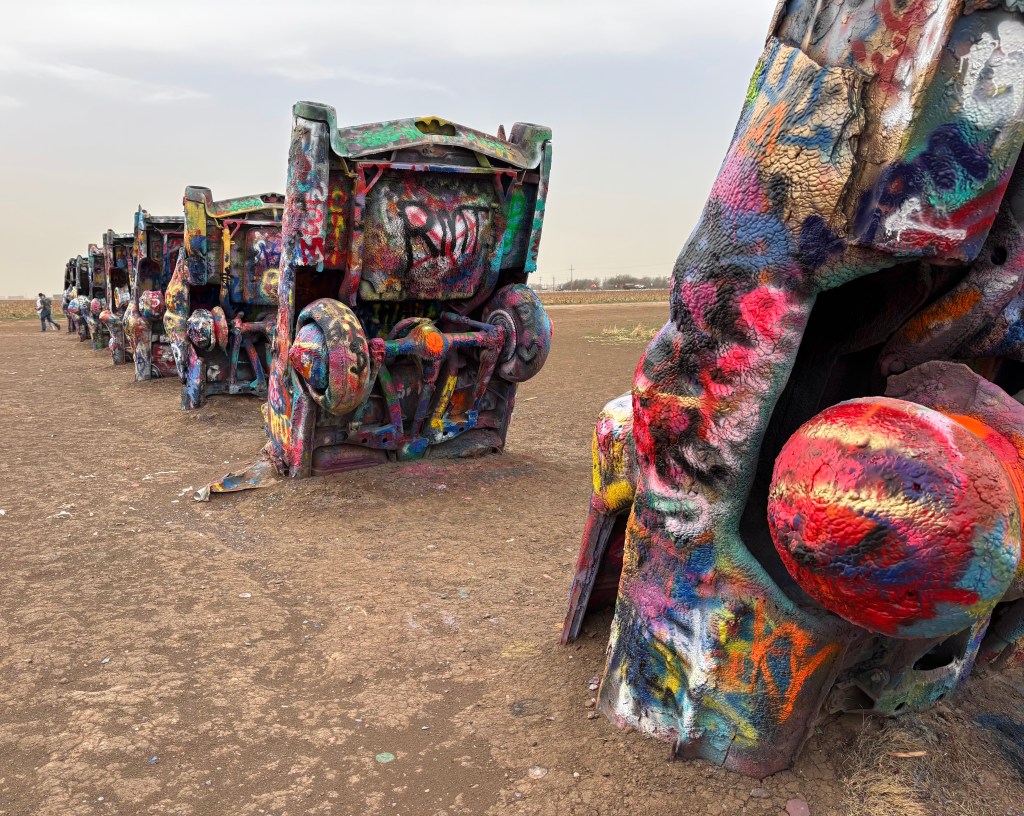
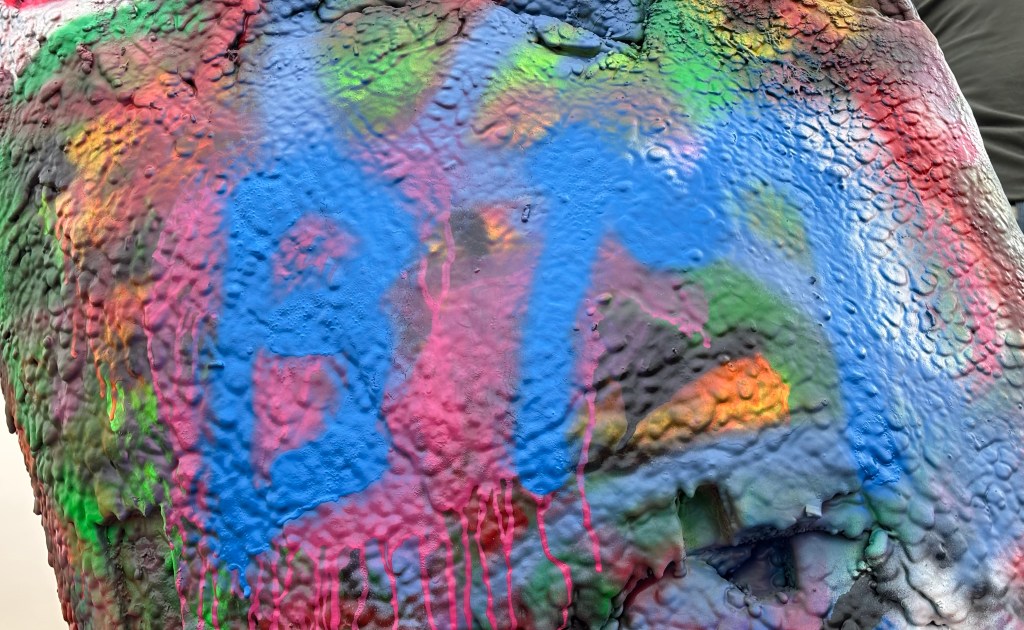
The cowboy was 1 mile from the last stop of the day – Cadillac Ranch. This is one of the most famous sites on Route 66. In collaboration with The Ant Farm, a San Francisco art collective, eccentric millionaire Stanley Marsh 3 (he found the Roman Numeral III pretentious) funded the placement of ten Cadillacs half-buried in a dusty field in 1974. The cars were positioned nosed down and facing west, inclined at the same angle as the pyramids of Giza. Most of the cars were purchased from junkyards and averaged about $200. At first, the cars displayed their original paint colors – turquoise, banana yellow, gold, and sky blue, but the installation was barely complete when people started scratching or painting their names on the cars. Marsh encouraged this and now spray paint is sold out of a truck on site. The cars are periodically repainted various colors, sometimes for TV commercials, to honor a birthday or death, or to provide a fresh canvas for future visitors. The cars were briefly “restored” to their original colors by the hotel chain Hampton Inn in a series of Route 66 landmark restoration projects. The new paint jobs and even the plaque commemorating the project lasted less than 24 hours without fresh graffiti. Cadillac Ranch was originally located in a wheat field, but in 1997 the installation was moved 2 miles west, to a cow pasture along I-40, in order to place it further from the limits of growing Amarillo. Both sites belonged to Marsh.
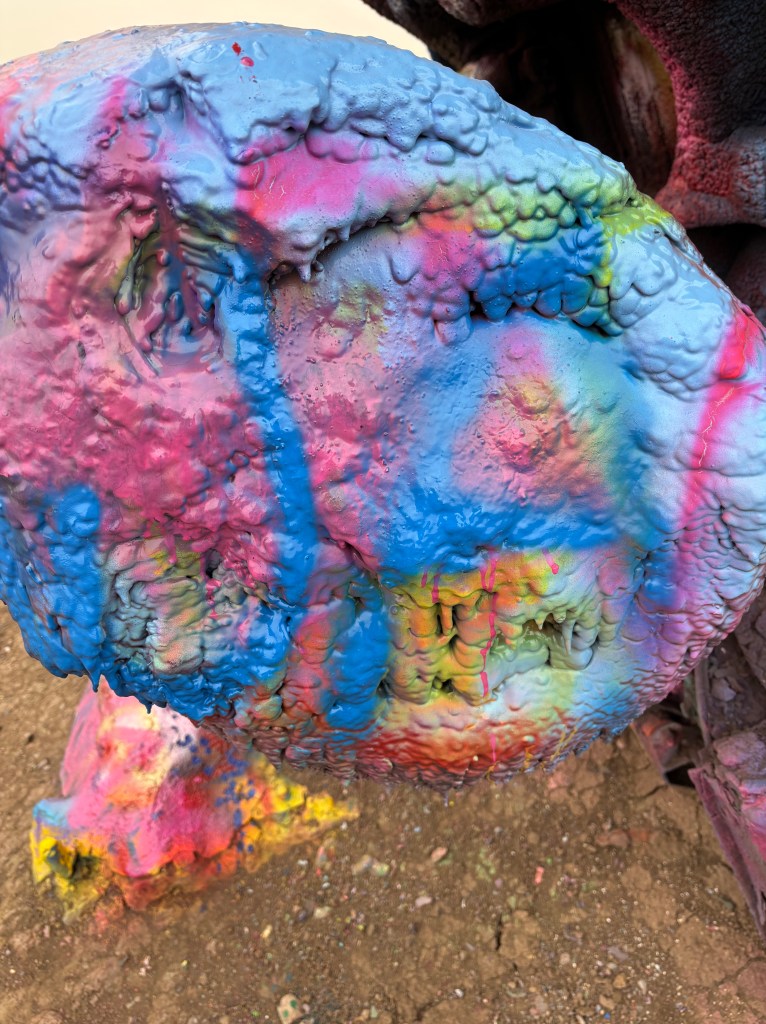
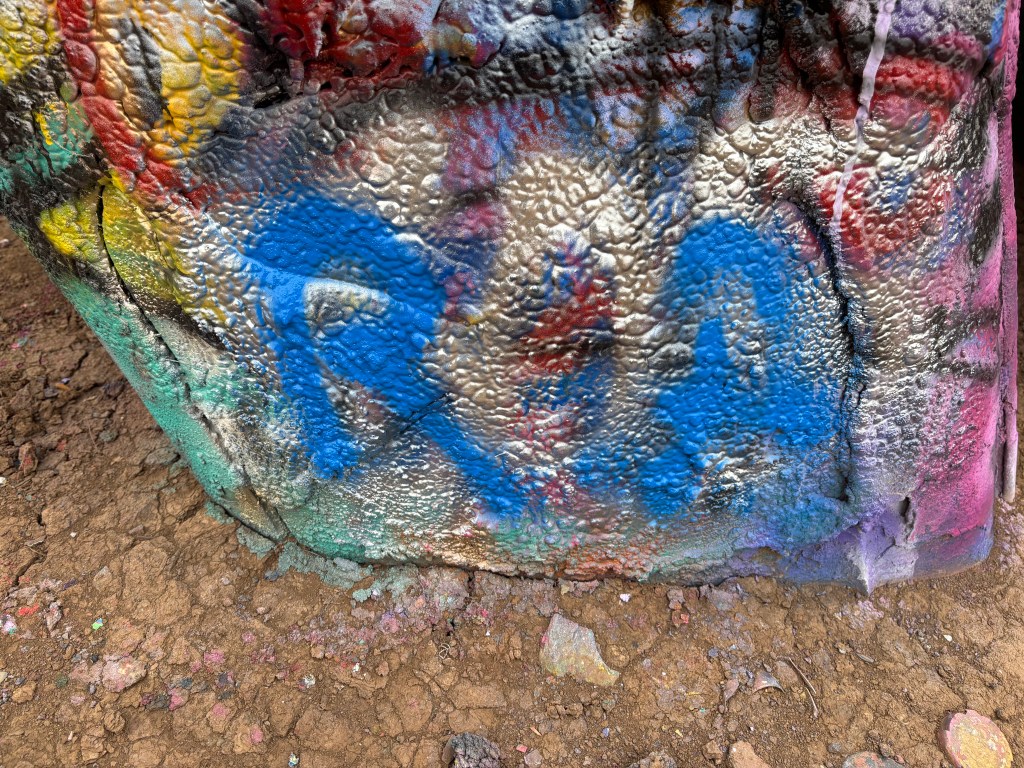
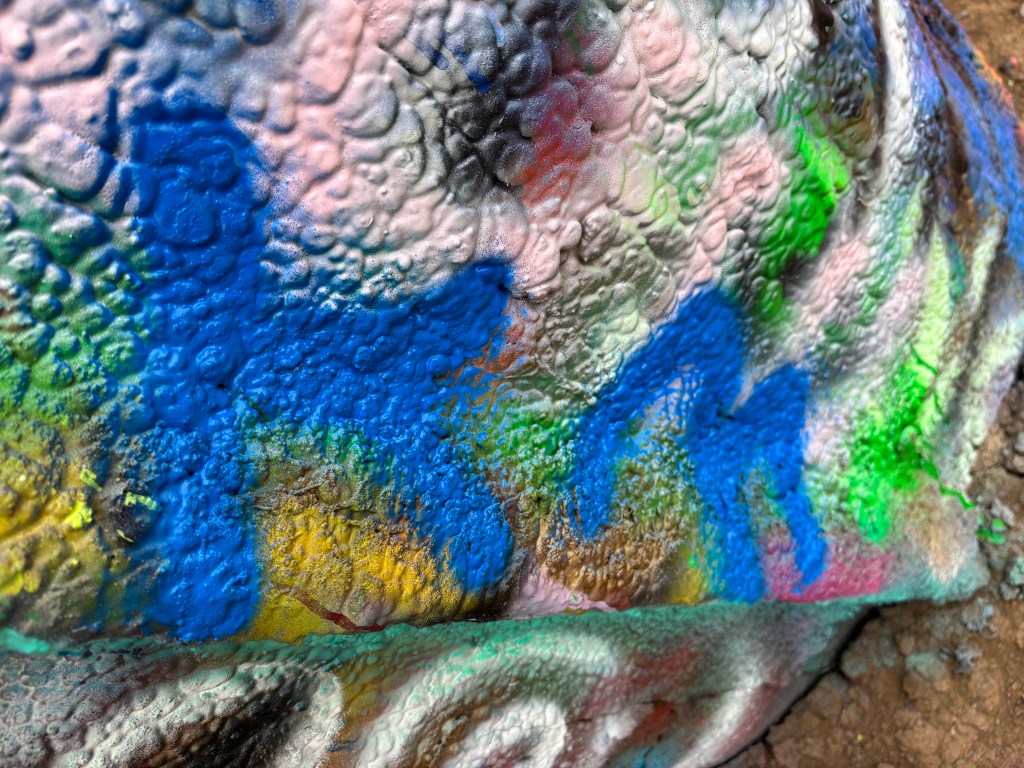
I put the can of spray paint I purchased at the shop with the 2nd Amendment Cowboy to use here. I sprayed the initials of our family members in places where the ever increasing dusty winds would not blow the paint back in my face. JA, RA, PA, KM, KM, BM, you are all here. Or you were. You may be painted over by now.
Covered in dust, eyes and mouth gritty, and needing a shower, I headed to the hotel. The sites today were fewer and further apart, but nonetheless fascinating to see. Tomorrow I head to Albuquerque and end the Route 66 portion of my adventure. I will be sad to see the last of the giant oddities.
Today was a busy day, chock full of sights for every age and interest. There was A LOT, so buckle up and we will hit the road!
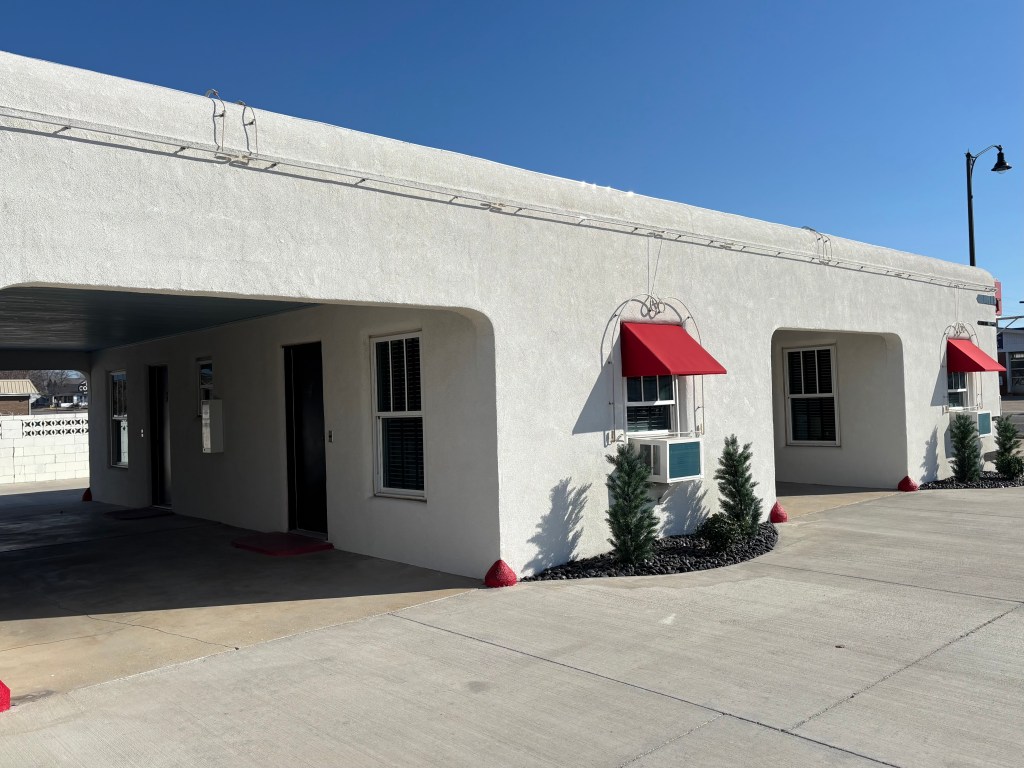
After eating my second donut from yesterday’s stop at the Donut Drive In (just as good as the first), I stopped at The Boots Court Motel. This was the most unusual motel I have ever seen. It was built in 1939 by Arthur Boots and featured the promotional slogan, “A Radio in Every Room!” Imagine- that was the selling point. To me the selling point was that you could drive right up to your door, undercover, and away from all the other cars. See the pic below:
And the front of the motel was just as cute.
It is presently being restored and there are five detached rooms in the back open for business. And with that, I left Missouri.
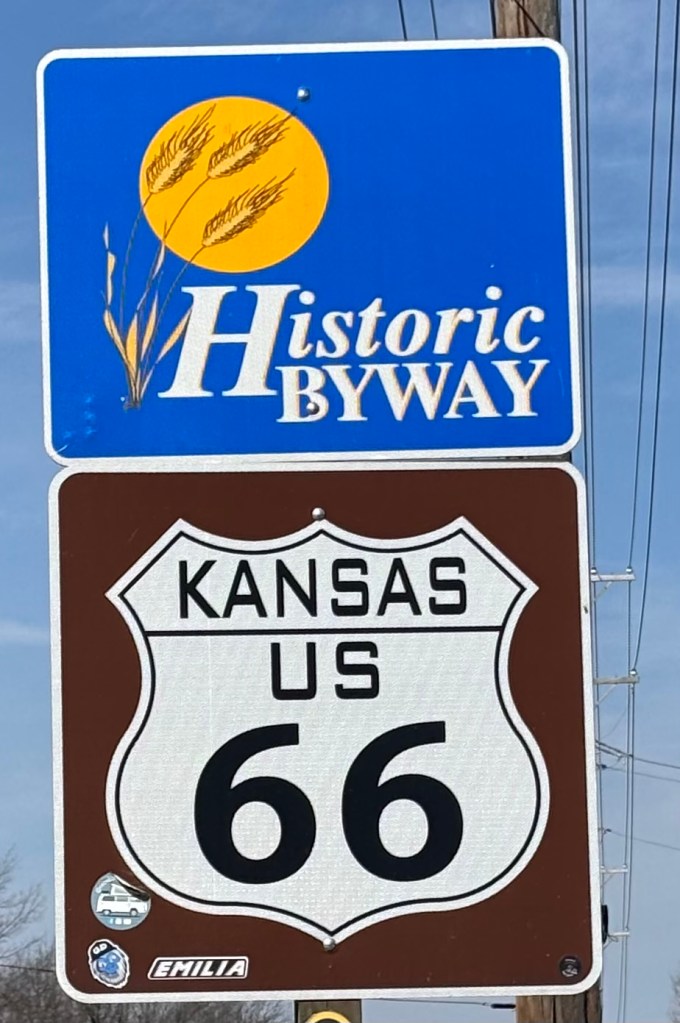
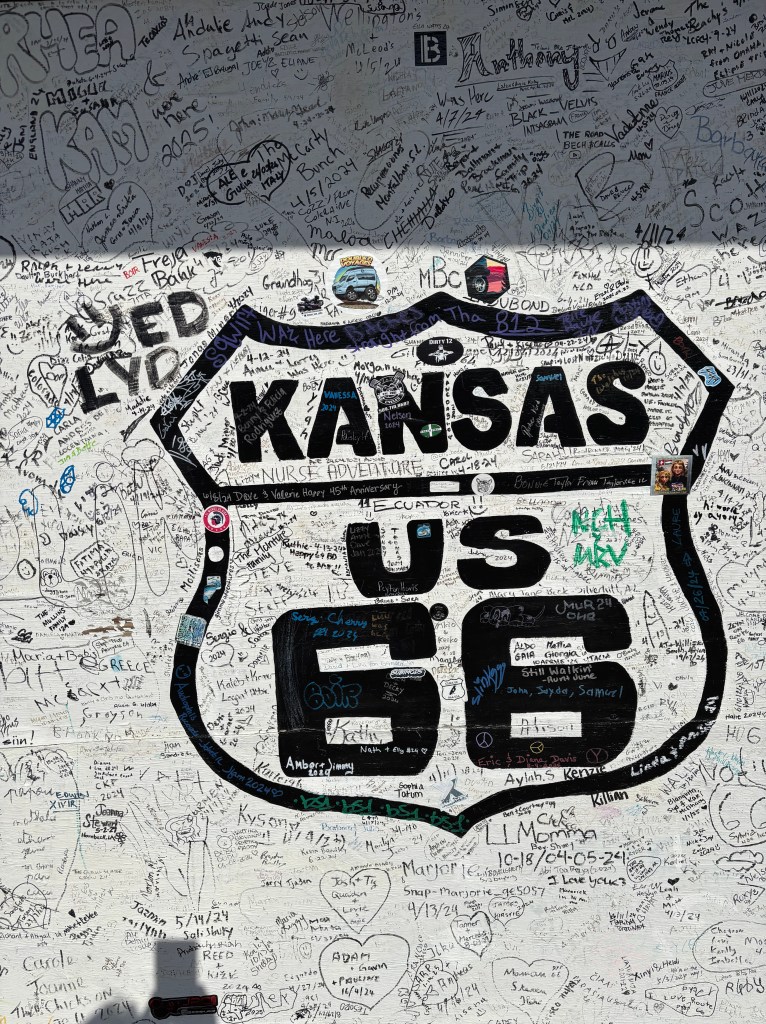
Welcome to Kansas with its 13 miles of Rt 66. Rt 66 goes through the tip of the southeast corner of the state and Kansas is very proud of that!
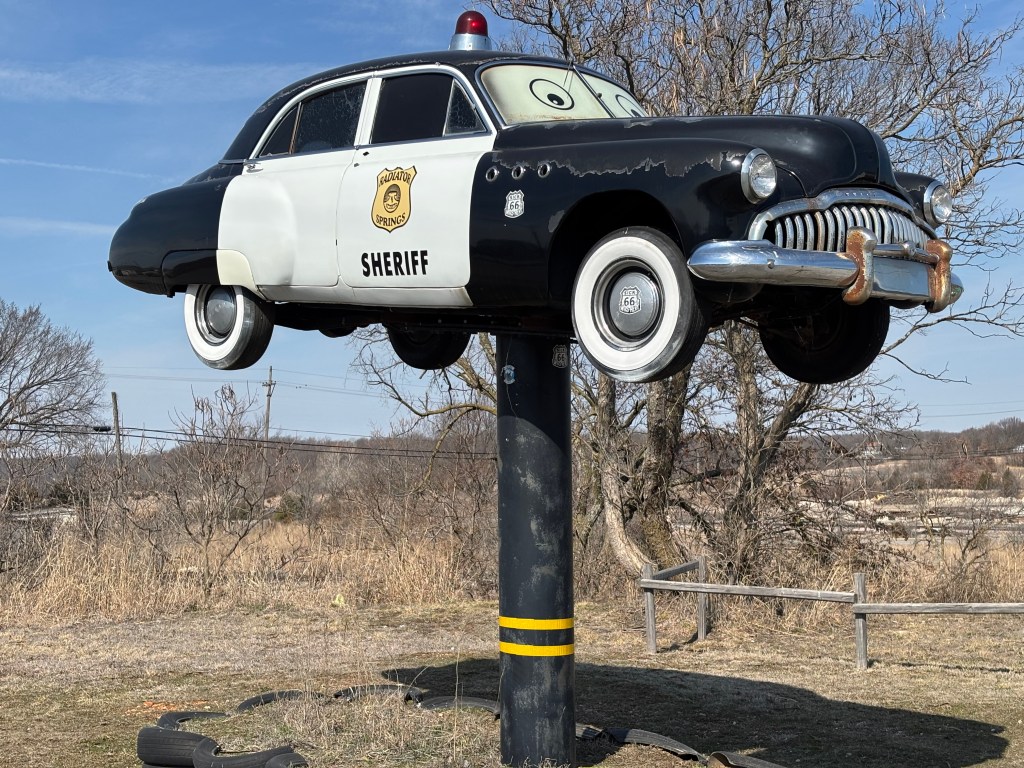
Rt 66 goes through three little towns in Kansas: Galena, Riverton and Baxter Springs. I stopped in the first and last. The town of Galena began in 1876 when Galena, a natural mineral form of lead sulfite, was first discovered there. It is the oldest mining town in Kansas, incorporated in 1877. The first stop was a facsimile of the 1949 Mercury police car that served as the Sheriff of Radiator Springs in the 2006 animated film “Cars.”
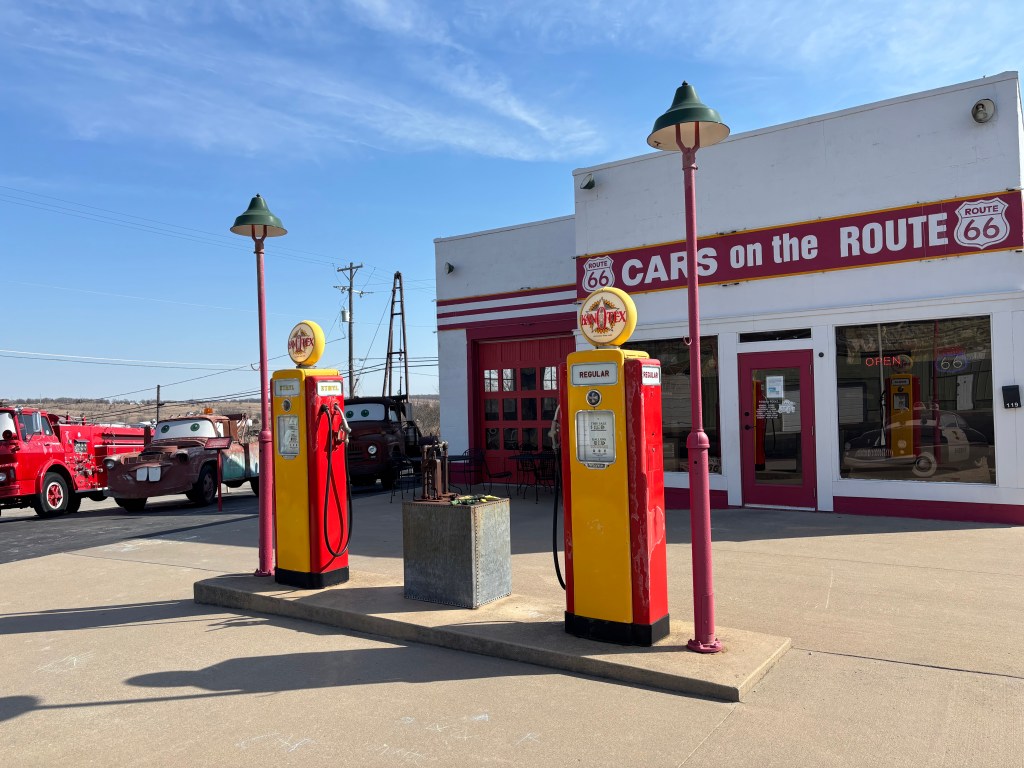
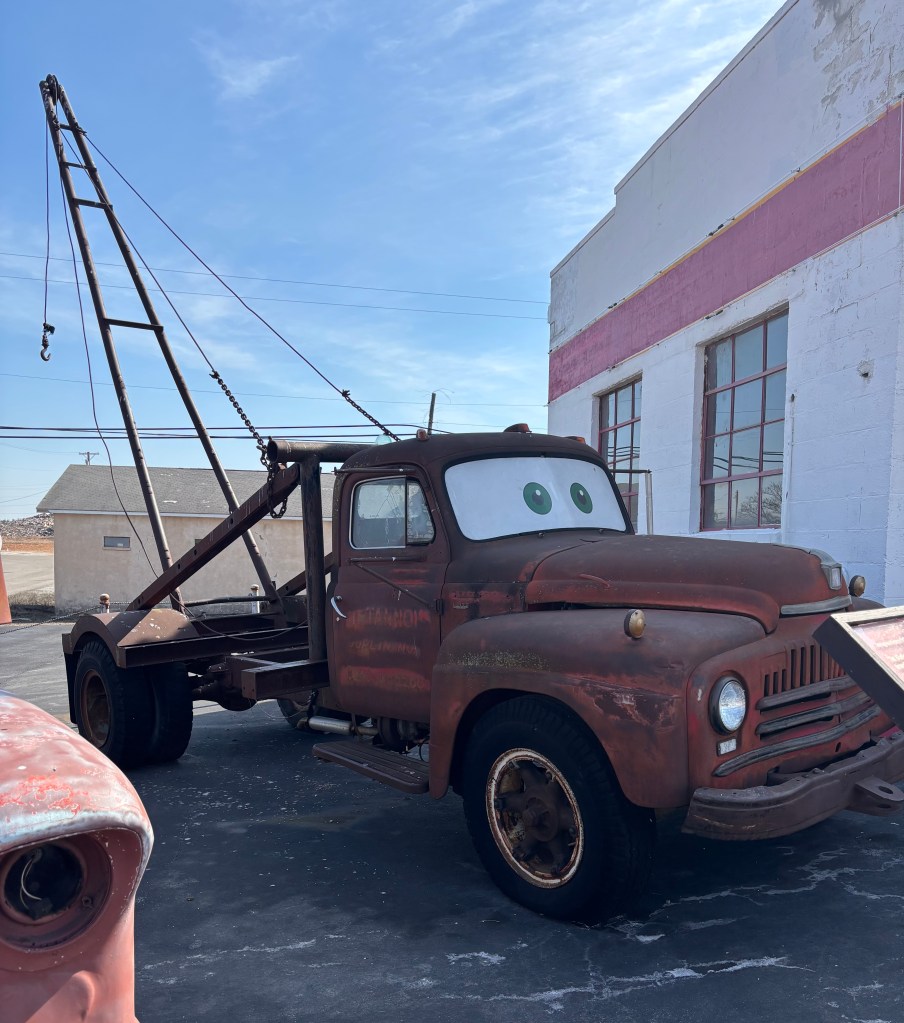
Around the corner, was an old Kan-O-Tex service station first opened in 1934. When director John Lasseter and story writer Joe Ranft were doing research for the movie “Cars”, they asked Rt 66 enthusiast Micheal Wallis to guide them on Rt 66, which he did for months. (They enjoyed him so much they asked him to voice the Sheriff in the movie, and he autographed the Sheriff’s car pictured above). When he took John and Joe to Galena, they saw an old tow truck against the wall next to the Kan-O-Tex station. It was a special tow truck with a long crane that it was used in the mines. This became the inspiration for Tow Mater, the tow truck in the movie. In 2007, the old service station was purchased and restored by four local women who wanted to renew interest in Kansas’ small portion of Route 66. Today the station is “Cars on the Route,” an homage to the Pixar movie. As I was taking a picture, the daughter of one of the women came out, told me the story about Mater and showed me around. She has lived in Galena nearly her entire life and said the movie “Cars” has renewed interest in Rt 66 and thereby Galena. Her town had fallen on hard times and is now thriving.
In Baxter Springs, the Baxter Springs Station (cleverly named) was constructed in 1930 as a gas station owned by the Independent Oil and Gas Company. Now the Kansas Route 66 Visitors Center it is open from May to November (not March to November as the guide book said).
What state was next? If you read the title, or really know your US geography you will know it was Oklahoma.
In 1889 settlers were allowed to race into parts of Oklahoma and stake claim to the land. Some managed to get to these spots before the territory was officially opened – they cheated. They were called “sooners,” which eventually became the state’s nickname: The Sooner State. (Or The Cheater State. I’m kidding, Oklahoma).
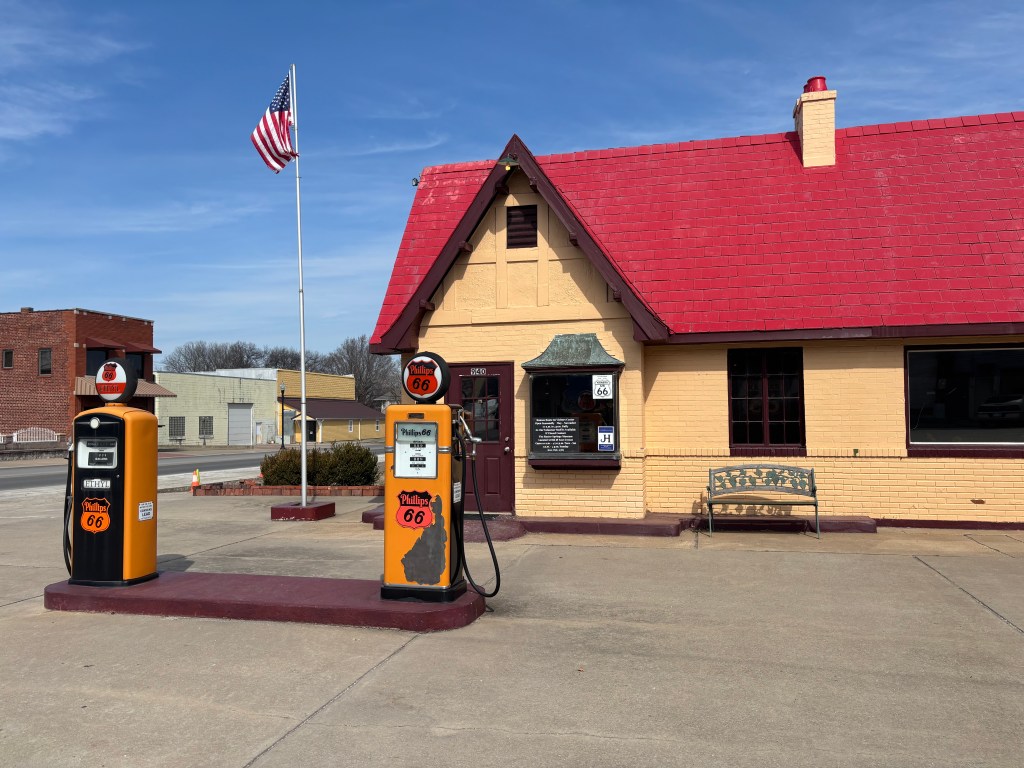
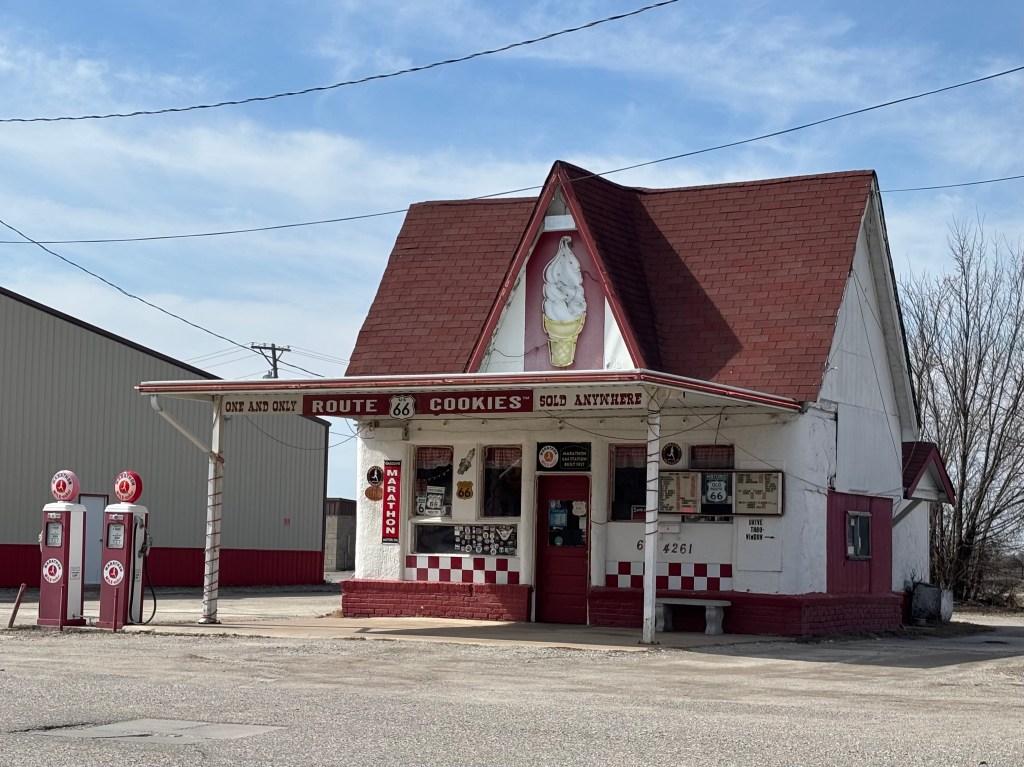
My first stop was a former Marathon gas station built in 1927 in the city of Commerce. In the 1930s it changed hands and soft serve ice cream was added in 1951. It is now a Dairy King and sell the one and only Rt 66 shaped vanilla cookies which are trademarked and made daily by hand. I was very interested in seeing what these looked like, however, they were closed. This will be a recurring theme. Things are not always open on Sunday, or late in the afternoon, or in March.
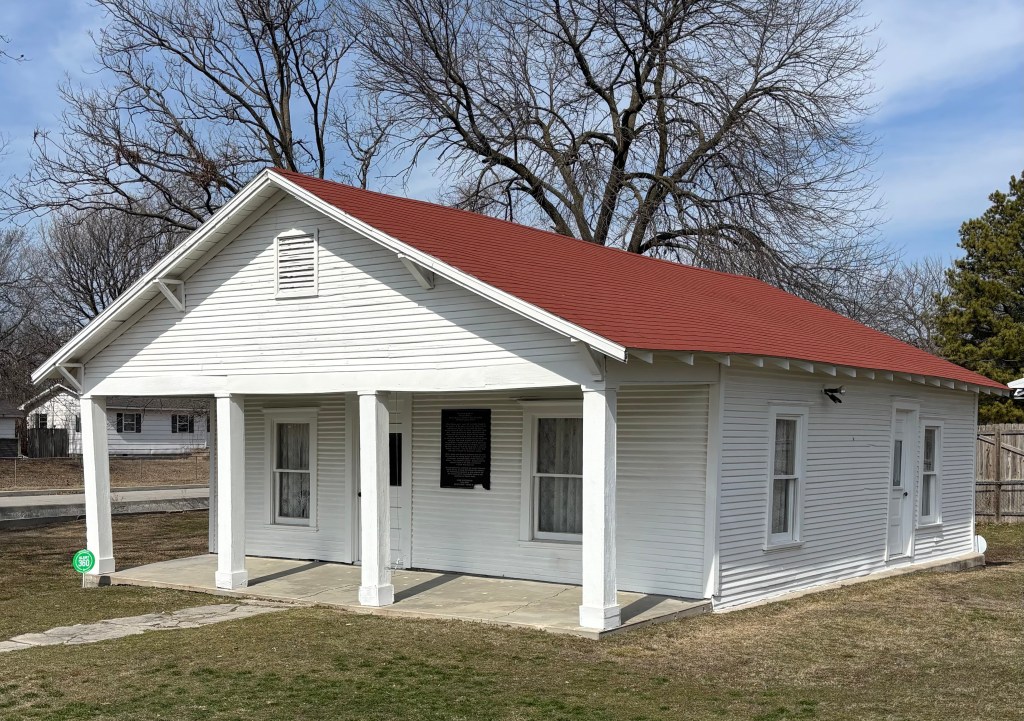
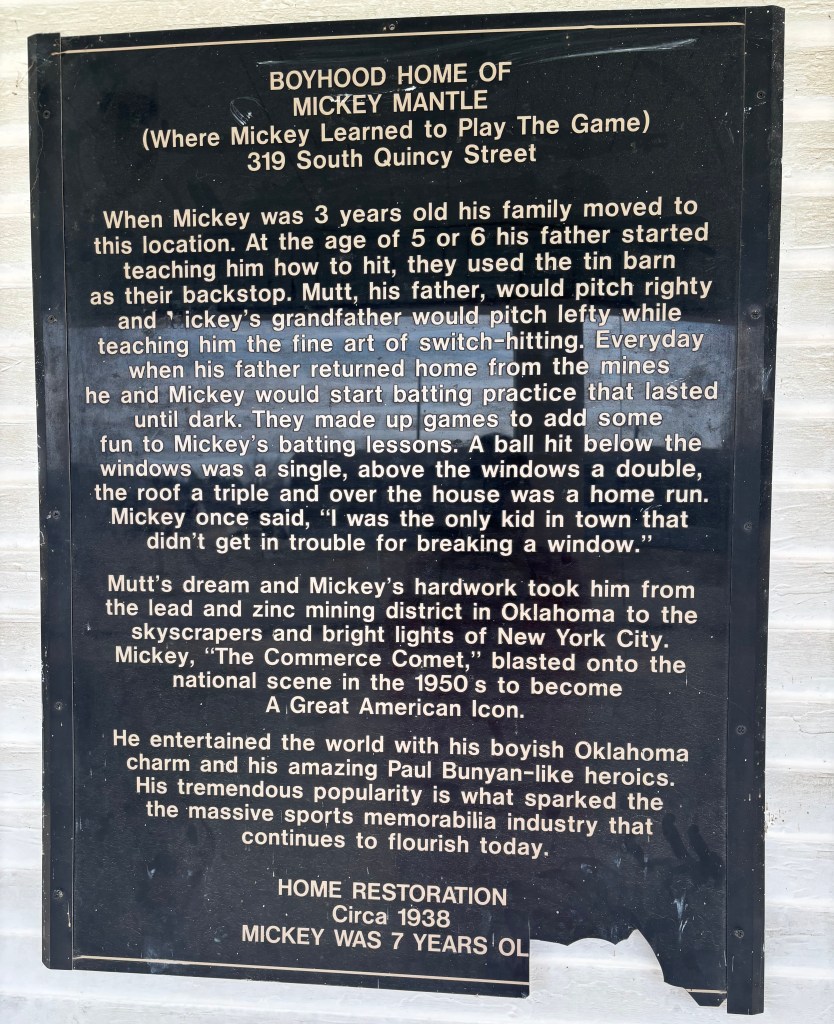
Commerce had something to show me that was not in the guidebook. As I was leaving town, there was a tiny blue sign that said,” Mickey Mantle’s Boyhood Home” and an arrow pointing down a side street. Knowing I had my Mona endorsed pepper spray with me in case I should run into trouble going off route, I made the turn. And there it was. Did you know he was called “The Commerce Comet”? I did not, nor did Rod, nor did my mother, nor, I suspect, do most people who live outside of Commerce, Oklahoma.
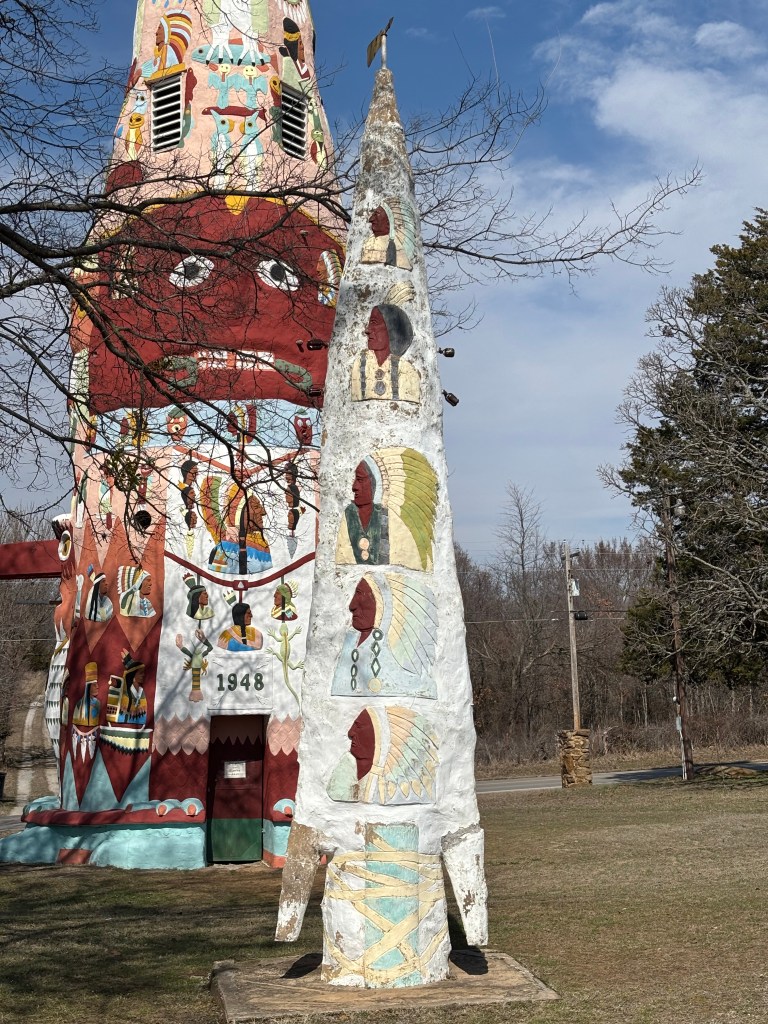
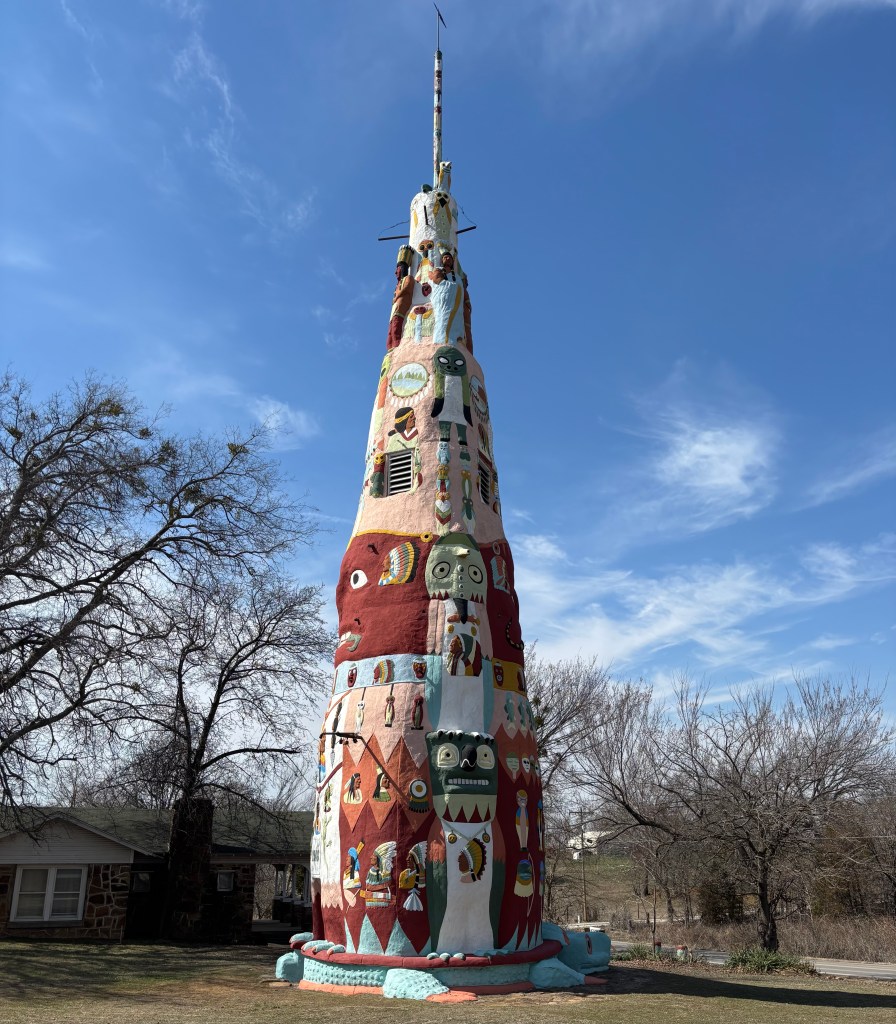
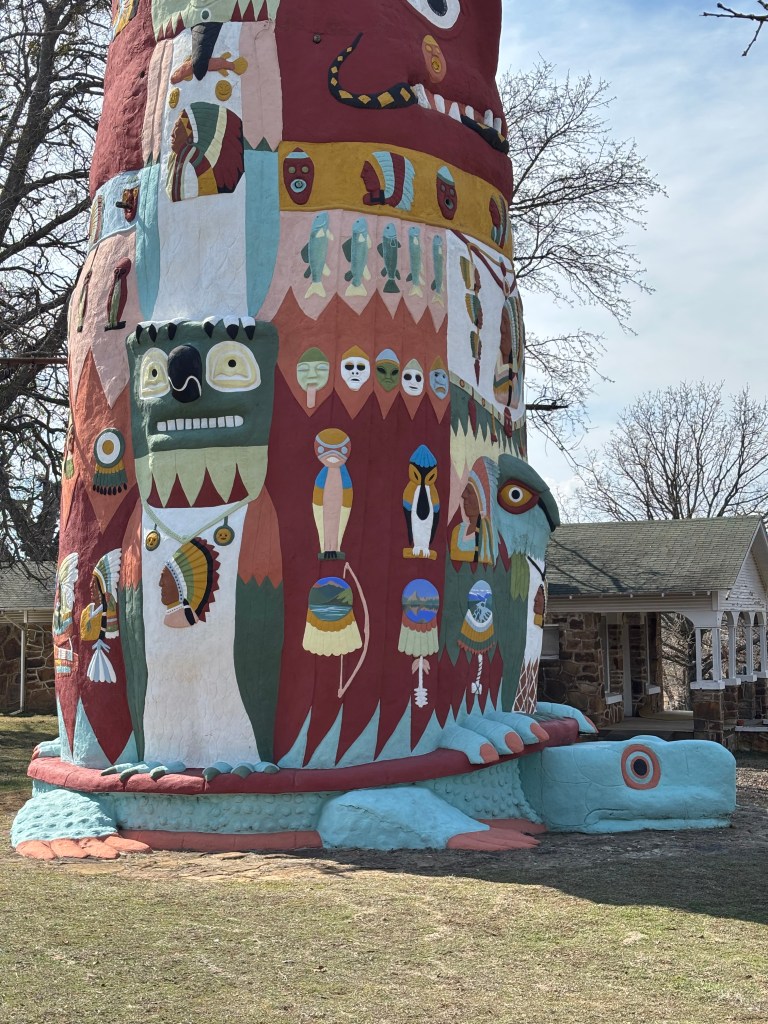
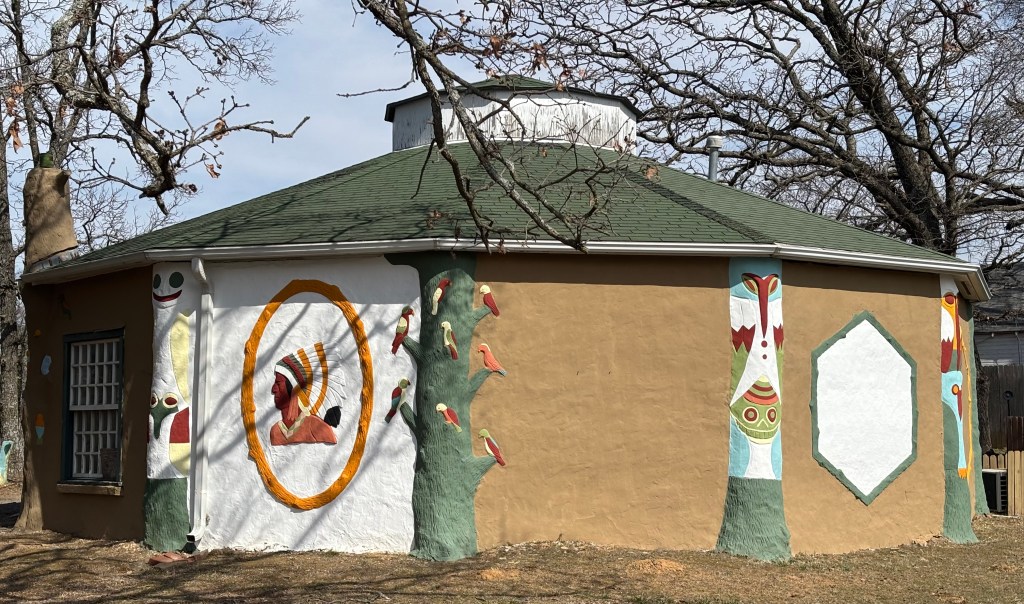
Between 1937 and 1963, Ed Galloway (1880-1963) built a visual art environment as a monument to the American Indian. He constructed 12 structures found at the Ed Galloway’s Totem Pole Park almost entirely with his own two hands. The Native American motif speaks to the history of the land of Oklahoma which was known as Indian Territory before the state of Oklahoma was established in 1907 as well as the shifting social realities of western expansion. It was here that the Trail of Tears terminated, depositing tribes from the south eastern United States in Oklahoma. Ed believed that the original inhabitants of this land should be honored and remembered, and he set out to do just that. The largest totem rises from the back of an enormous turtle which was carved from an outcrop of sandstone evoking the indigenous term ‘Turtle Island’ or North America. It features over 200 hand sculpted bas-relief creatures and Native American portraits. It is estimated that 28 tons of cement, 6 tons of steel, and 100 tons of sand and rock comprise the 90 foot tall structure that took Ed 11 years to complete. What was more amazing to me was that he collected the sand for the cement from the creek bed running on the west side of his property and used a hand crank drill to cut the rocks to be shaped. (Information sourced from Erin Turner, Site Curator & Restoration Artist, 2021)
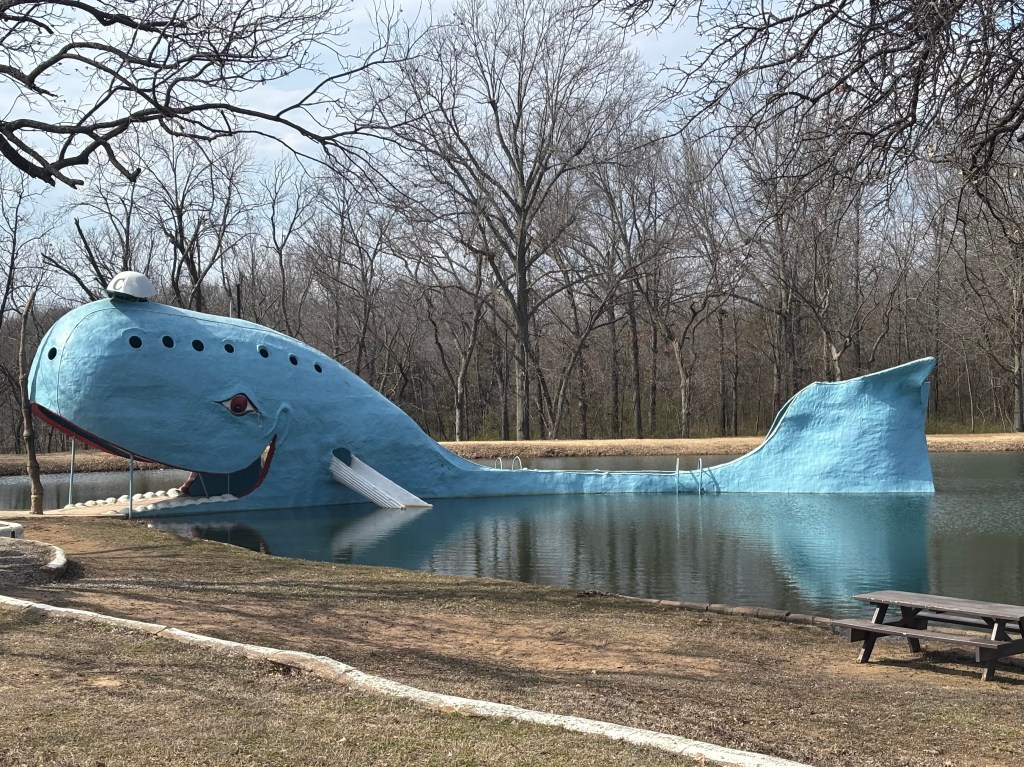
I moved on from this inspiring place to one which was sweet but rather silly – the Blue Whale. Hugh Davis built this Blue Whale in July 1972 as a surprise anniversary present for his wife, Zelta, who collected whale figurines. The Blue Whale and its pond became a favorite swimming spot for both locals and travelers. It is still owned by Davis’ daughter, but swimming is no longer permitted. You can walk through the whale and once upon a time could slide down his fins (looks like litigation waiting to happen).
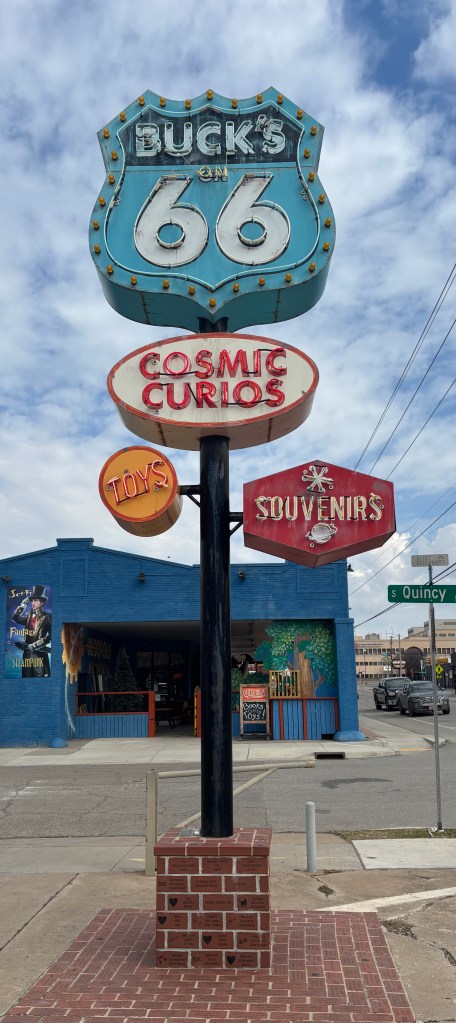
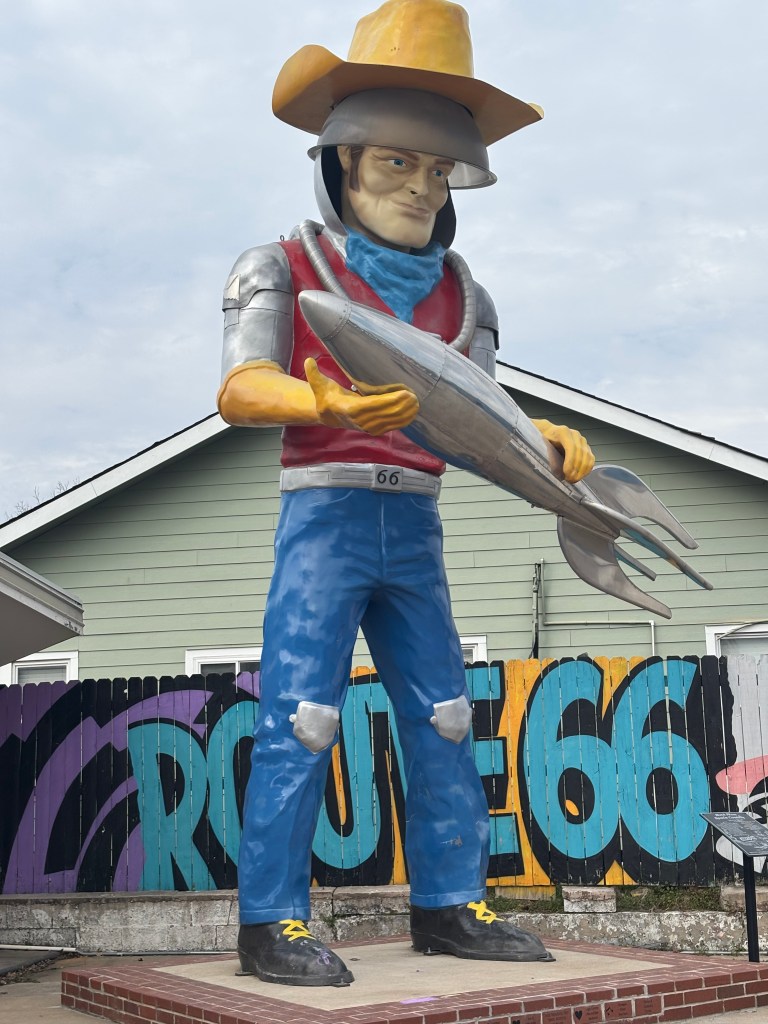
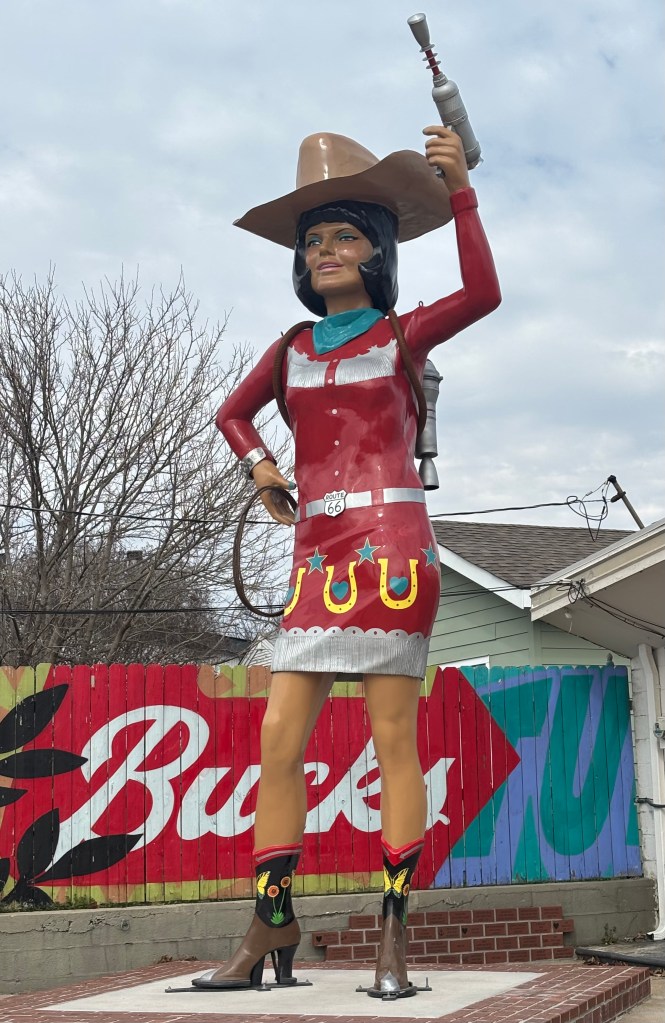
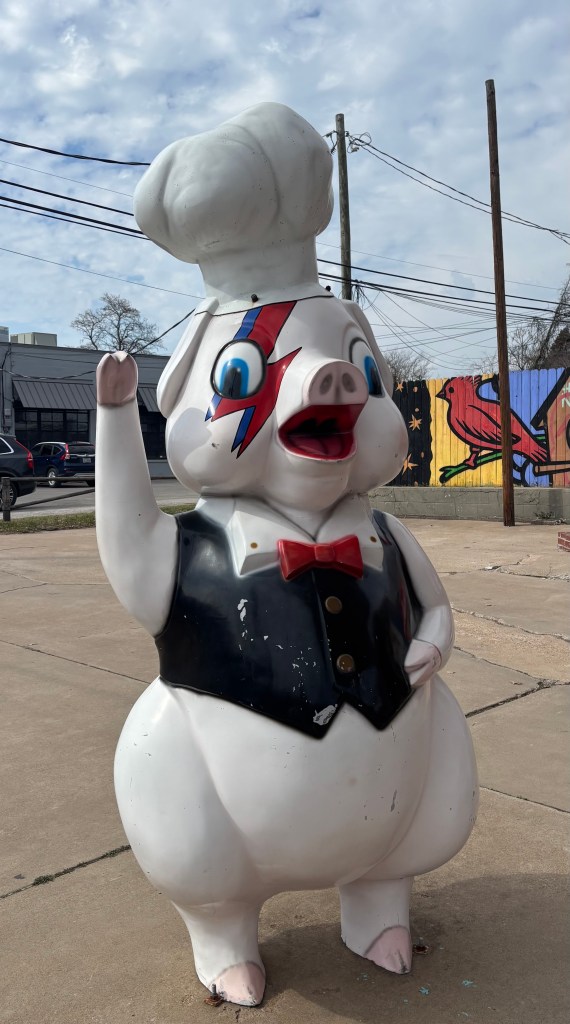
In Tulsa, in the former site of a 1950s PEMCO gas station, was Buck Atom’s Cosmic Curios. If you want to celebrate the “magic of Route 66 with apparel, toys, souvenirs, art, jewelry, and more” this is the place for you. So that you don’t miss it, there are two giant statues, Buck Atom, the Space Cowboy, and Stella, the Space Cowgirl. There is also Piggy Stardust, but he is not giant. Route 66 loves giant things.
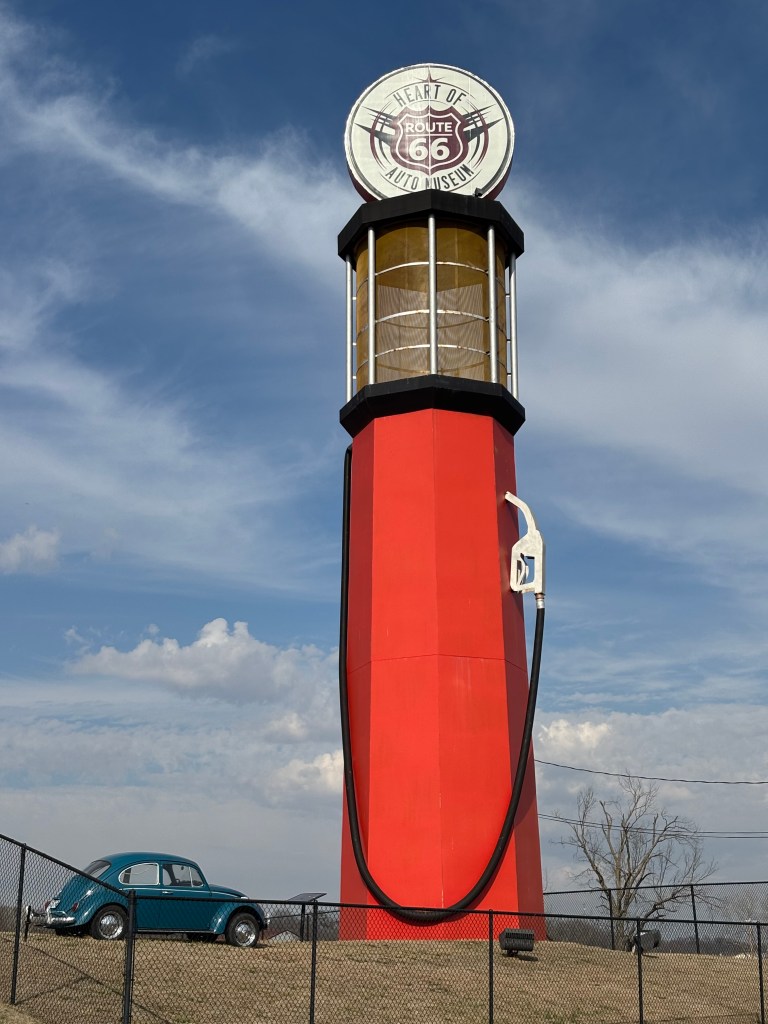
If you were hoping I would see a giant gas pump…
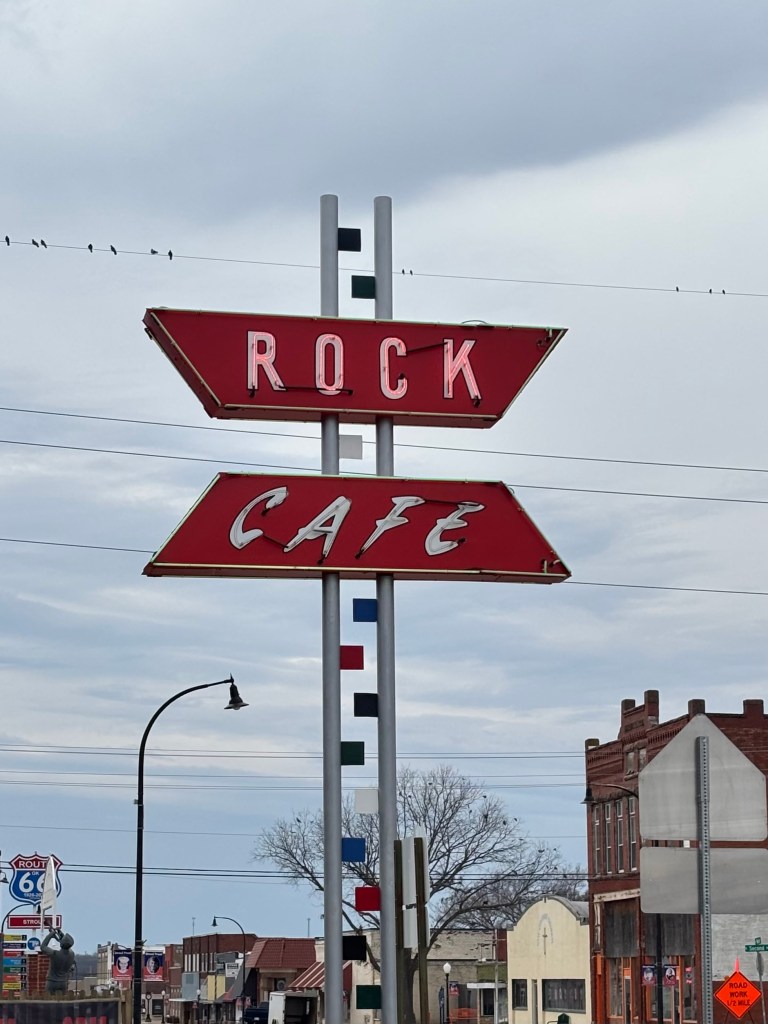
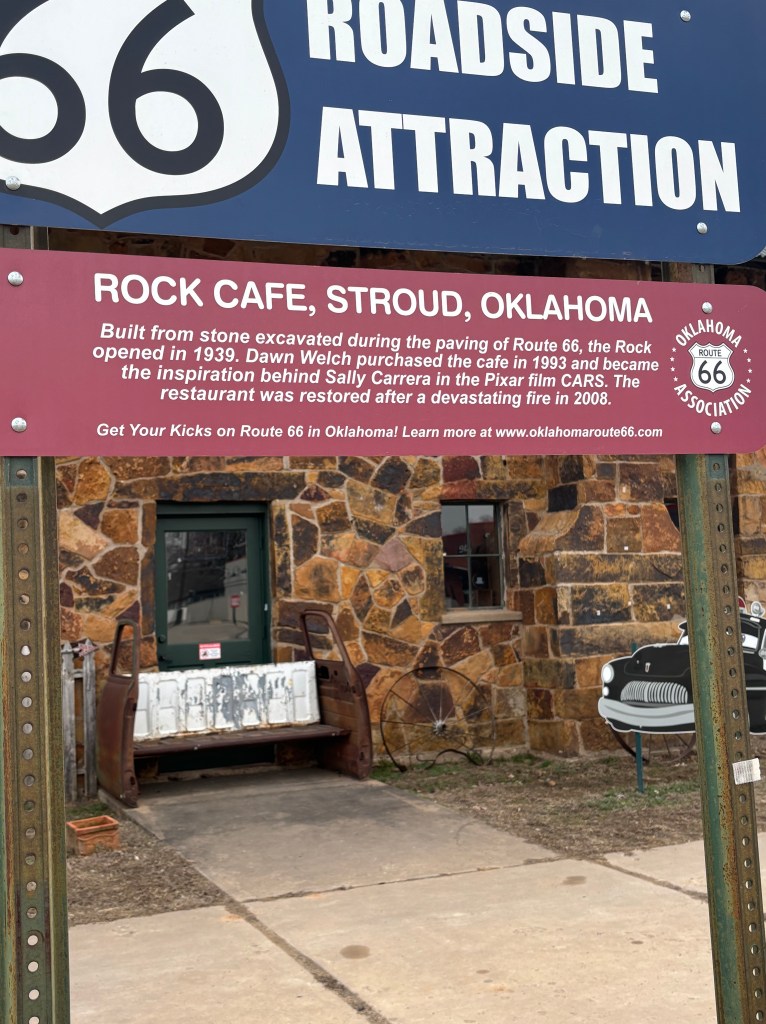
John Lasseter and the research team for Pixar’s movie “Cars” visited the Rock Cafe in 2001 and upon meeting owner Dawn Welch began developing the character Sally Carrera. They made multiple visits from 2001-2005. It was built in 1936 from the stone excavated during the paving of Rt 66 and opened in 1939 with the neon sign installed in the late 1940s. I was so disappointed that it closed at 2 pm and I was there at 3: 15, I forgot to take a picture of the entire cafe. You can see some of the stone behind the information sign, though. I was also hungry as I had planned on eating there. I am sure this added to my forgetfulness.
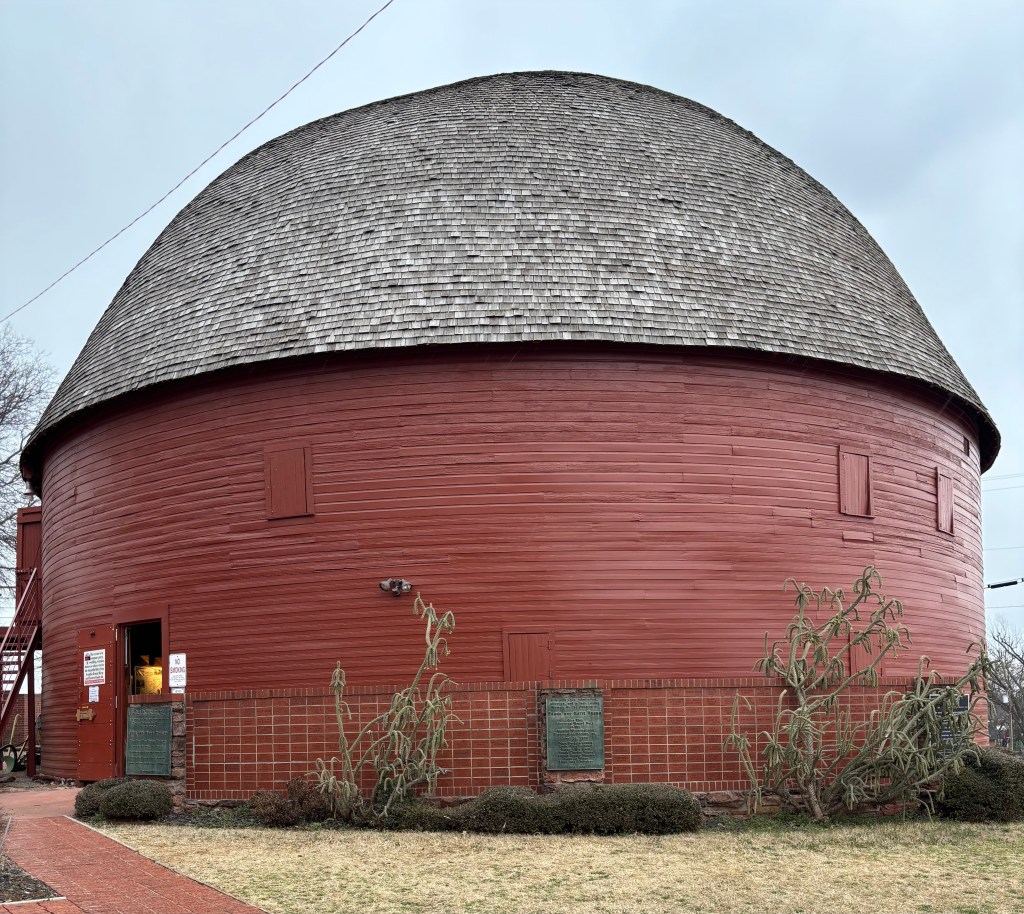
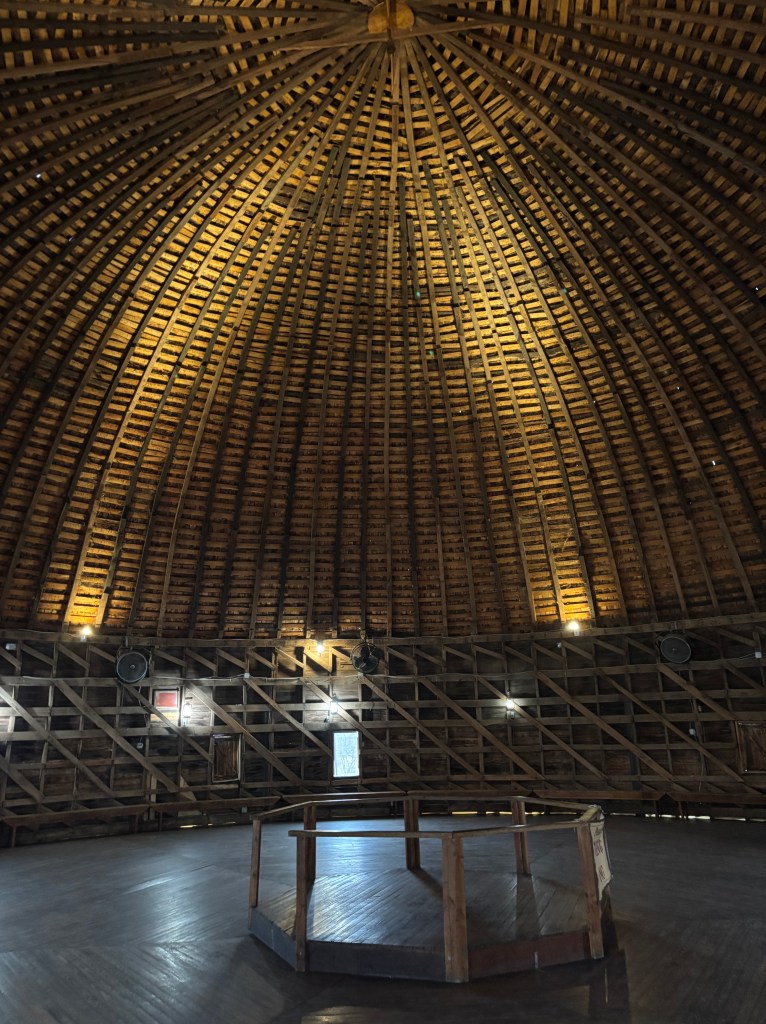
As I had missed the open window of the Rock Cafe, I decided to check the times for the next stop. When I plugged it into the GPS, I was informed I would arrive 10 minutes before it would close. So instead of using Route 66, I got on the interstate, knowing it would be quicker. Apparently, folks in Oklahoma need to get from here to there at speed. The interstate speed limit is 80, I was going 85, and people were zipping past me. It is 65 in construction zones! Needless to say I arrived at Round Barn before it closed. Round Barn was built by local farmer William Harrison Odor in 1898. He made the rounded walls and roof rafters by soaking green native bur oak boards and bending them into curves. It is 60 feet in diameter and 43 feet tall. William thought if the barn was round, the extreme winds of tornadoes would strike and flow around it instead of through it. In the early 20th century, round barns were said to be “cyclone-proof”, but there is no scientific evidence to support this. However, the barn is still standing, it can be rented for events, and every week it hosts Saturday Morning Music Sessions.
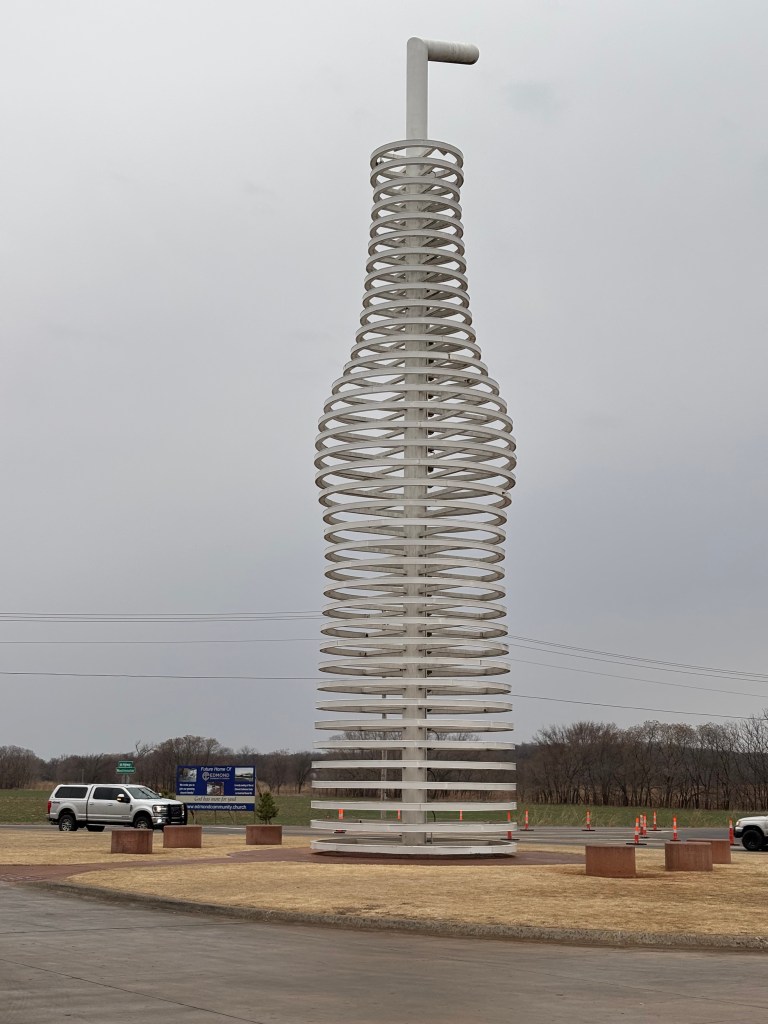
As I was heading to Oklahoma City, I came upon my last stop of the day, Pops Soda Ranch. The specialty beverage maker offers a signature collection of 700 kinds of soda, sparkling waters, and ice-cold refreshments. The structure, which opened in 2007, incorporates a cantilevered truss extending 100 feet over the gas pumps and a parking area. The roadside sign is a 66 foot tall soda bottle. Alas, the main area was closed for renovations so I was unable to purchase a bottle of bacon flavored soda, which I thought would be “Eww, Munger Moss”, but fun to have. I did however, purchase a hat with the soda bottle logo on it so all was not lost.
The rain was just starting as I left Pops Soda Ranch. I am now tucked up in my hotel looking forward to another day. I wonder how many more giant things I will see?
Today was a busy day, chock full of sights for every age and interest. There was A LOT, so buckle up and we will hit the road!
After eating my second donut from yesterday’s stop at the Donut Drive In (just as good as the first), I stopped at The Boots Court Motel. This was the most unusual motel I have ever seen. It was built in 1939 by Arthur Boots and featured the promotional slogan, “A Radio in Every Room!” Imagine- that was the selling point. To me the selling point was that you could drive right up to your door, undercover, and away from all the other cars. See the pic below:
And the front of the motel was just as cute.
It is presently being restored and there are five detached rooms in the back open for business. And with that, I left Missouri.
Welcome to Kansas with its 13 miles of Rt 66. Rt 66 goes through the tip of the southeast corner of the state and Kansas is very proud of that!
Rt 66 goes through three little towns in Kansas: Galena, Riverton and Baxter Springs. I stopped in the first and last. The town of Galena began in 1876 when Galena, a natural mineral form of lead sulfite, was first discovered there. It is the oldest mining town in Kansas, incorporated in 1877. The first stop was a facsimile of the 1949 Mercury police car that served as the Sheriff of Radiator Springs in the 2006 animated film “Cars.”
Around the corner, was an old Kan-O-Tex service station first opened in 1934. When director John Lasseter and story writer Joe Ranft were doing research for the movie “Cars”, they asked Rt 66 enthusiast Micheal Wallis to guide them on Rt 66, which he did for months. (They enjoyed him so much they asked him to voice the Sheriff in the movie, and he autographed the car pictured above). When he took John and Joe to Galena, they saw an old tow truck against the wall next to the old Kan-O-Tex station. It had a long crane because it was used in the mines. This became the inspiration for Tow Mater, the tow truck in the movie. In 2007 the old service station was purchased and restored by four local women who wanted to renew interest in Kansas’ small portion of Route 66. Today the station is “Cars on the Route,” an homage to the Pixar movie. As I was taking a picture, the daughter of one of the women came out, told me the story about Mater and showed me around. She has lived in Galena nearly her entire life and said the movie “Cars” has renewed interest in Rt 66 and thereby Galena. Her town had fallen on hard times and is now thriving.
In Baxter Springs, the Baxter Springs Station (cleverly named) was constructed in 1930 as a gas station owned by the Independent Oil and Gas Company. it is now the Kansas Route 66 Visitors Center open from May to November (not March to November as the guide book said).
What state was next? If you read the title, or really know your US geography you will know it was Oklahoma.
In 1889 settlers were allowed to race into parts of Oklahoma and stake claim to the land. Some managed to get to these spots before the territory was officially opened. They were called “sooners,” which eventually became the state’s nickname: The Sooner State.
My first stop was a former Marathon gas station built in 1927 in the city of Commerce. In the 1930s it changed hands and soft serve ice cream was added in 1951. It is now a Dairy King and sell the one and only Rt 66 shaped vanilla cookies which are trademarked and made daily by hand. I was very interested in seeing what these looked like, however, they were closed. This will be a recurring theme. Things are not always open on Sunday, or late in the afternoon, or in March.
Commerce had something to show me that was not in the guidebook. As I was leaving town, there was a tiny blue sign that said,” Mickey Mantle’s Boyhood Home” and an arrow pointing down a side street. Knowing I had my Mona endorsed pepper spray with me in case I should run into trouble going off route, I made the turn. And there it was. Did you know he was called “The Commerce Comet”? I did not, nor did Rod, nor did my mother, nor do most people who live outside of Commerce, Oklahoma, I suspect.
Between 1937 and 1963, Ed Galloway (1880-1963) built a visual art environment as a monument to the American Indian. He constructed 12 structures found at the Ed Galloway’s Totem Pole Park almost entirely with his own tow hands. The Native American motif speaks to the history of the land of Oklahoma which was known as Indian Territory before the state of Oklahoma was established in 1907 as well as the shifting social realities of western expansion. It was here that the Trail of Tears terminated, depositing tribes from the south eastern United States in Oklahoma. Ed believed that the original inhabitants of this land should be honored and remembered, and he set out to do just that. The largest totem rises from the back of an enormous turtle which was carved from an outcrop of sandstone evoking the indigenous term ‘Turtle Island’ or North America. It features over 200 hand sculpted bas-relief creatures and Native American portraits. It is estimated that 28 tons of cement, 6 tons of steel, and 100 tons of sand and rock comprise the 90 foot tall structure that took Ed 11 years to complete. What was more amazing to me is that he collected the sand for the cement from the creek bed running on the west side of his property and used a hand crank drill to cut the rocks to be shaped. (Information sourced from Erin Turner, Site Curator & Restoration Artist, 2021)
I moved on from this inspiring place to one which was sweet but rather silly – the Blue Whale. Hugh Davis built this Blue Whale in July 1972 as a surprise anniversary present for his wife, Zelta, who collected whale figurines. The Blue Whale and its pond became a favorite swimming spot for both locals and travelers. It is still owned by Davis’ daughter, but swimming is no longer permitted. You can walk through the whale and once upon a time could slide down his fins (looks like litigation waiting to happen).
In Tulsa, in the former site of a 1950s PEMCO gas station, was Buck Atom’s Cosmic Curios. If you want to celebrate the “magic of Route 66 with apparel, toys, souvenirs, art, jewelry, and more” this is the place for you. So that you don’t miss it, there are two giant statues, Buck Atom, the Space Cowboy, and Stella, the Space Cowgirl. There is also Piggy Stardust, but he is not giant. Route 66 loves giant things.
If you were hoping I would see a giant gas pump…
John Lasseter and the research team for Pixar’s movie “Cars” visited the Rock Cafe in 2001 and upon meeting owner Dawn Welch began developing the character Sally Carrera. They made multiple visits from 2001-2005. It was built in 1936 from the stone excavated during the paving of Rt 66 and opened in 1939. The neon sign was installed in the late 1940s. I was so disappointed that it closed at 2 pm and I was there at 3: 15, I forgot to take a picture of the entire cafe. You can see some of the stone behind the information sign, though. I was also hungry as I had planned on eating there. I am sure this added to my forgetfulness.
As I had missed the open window of the Rock Cafe, I decided to check the times for the next stop. When I plugged it in the GPS, I was informed I would arrive 10 minutes before it would close. So instead of using Route 66, I got on the interstate, knowing it would be quicker. Apparently, folks in Oklahoma need to get from here to there at speed. The interstate speed limit is 80, so I decided to go 85, and people were zipping past me. It is 65 in construction zones! Needless to say I arrived at Round Barn before it closed. Round Barn was built by local farmer William Harrison Odor in 1898. He made the rounded walls and roof rafters by soaking green native bur oak boards and bending them into curves. It is 60 feet in diameter and 43 feet tall. William figured if the barn was round, the extreme winds of tornadoes would strike and flow around it instead of through it. In the early 20th century, round barns were said to be “cyclone-proof”, but there is no scientific evidence to support this. However, the barn is still standing, it can be rented for events, and every week it hosts Saturday Morning Music Sessions.
As I was heading to Oklahoma City, I came upon my last stop of the day, Pops Soda Ranch. The specialty beverage maker offers a signature collection of 700 kinds of soda, sparkling waters, and ice-cold refreshments. The structure, which opened in 2007, incorporates a cantilevered truss extending 100 feet over the gas pumps and a parking area. The roadside sign is a 66 foot tall soda bottle. Alas, the main area was closed for renovations so I was unable to purchase a bottle of bacon flavored soda, which I thought would be “Eww, Munger Moss”, but fun to have. I did however, purchase a hat with the soda bottle logo on it so all was not lost.
The rain was just starting as I left Pops Soda Ranch. I am now tucked up in my hotel looking forward to another day. I wonder how many more giant things I will see?
I did in fact leave very close to 8 am this morning.
I pulled out of the drive at 8:06. For those of you thinking, “Oh dear, is she going to give us minute by minute for two weeks?”, no. I just want to be accurate starting out. Who knows what I will be writing at the end of this.
I drove 5 hours to St Louis, MO. There I picked up Route 66. My plan is to stop at what I want to see on Route 66 until I get to Albuquerque, New Mexico. For those unfamiliar, Rt. 66 is a decommissioned highway that runs 2278 miles from Chicago to Santa Monica, CA. It was finished in 1928, but as high speed interstate highways appeared near it, it became less and less used. It disappeared from official records in 1984 and was decommissioned in 1985. Official signage was removed, but each state has made efforts to preserve its legacy by erecting new signs and painting new road shields. Approximately 85% of the original highway can be driven, however, in some areas the interstate highway must be used.
The first stop was the Gateway Arch. This 630 foot arch built between Feb. 1963-Oct. 1965 is the world’s tallest arch. Some sources consider it the world’s tallest human-made monument in the Western Hemisphere. It honors the early 19th century explorations of Lewis and Clark and America’s westward expansion. Having been to the Arch several times before, I did not go to the top. I did illegally park to get a picture.
The next stop was the Donut Drive In. Opened in 1953, this is reported to have the best donuts on Rt. 66. How could I not stop there? I ordered 4 donuts and ate one. It was fabulous. Am saving the rest for later.
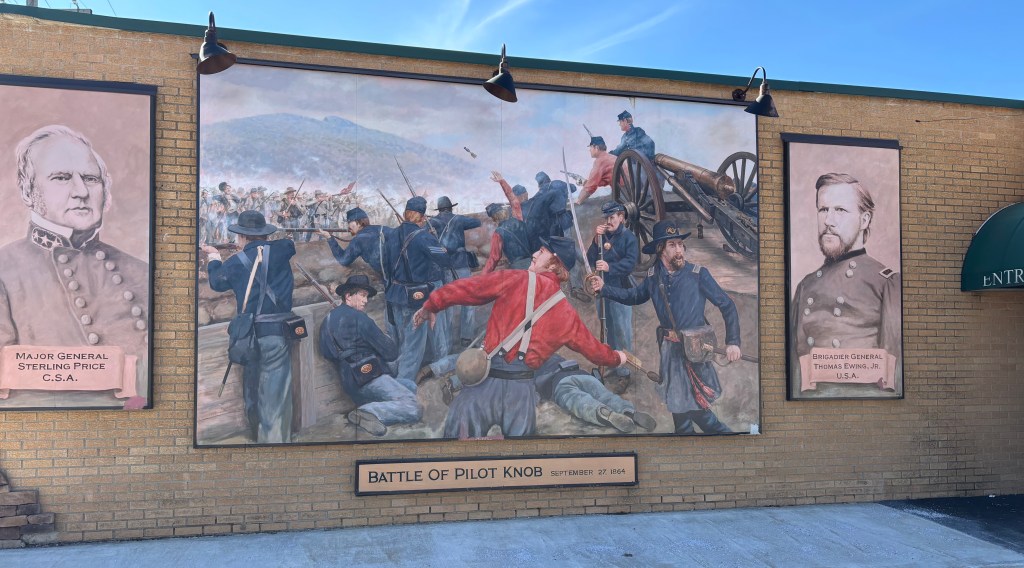
Next up was an 1.25 hour drive to Cuba, MO. This is a tiny town that is known as Mural City. It contains 14 murals depicting various historical figures and events of the region. Below shows the Civil War Battle of Pilot Knob.
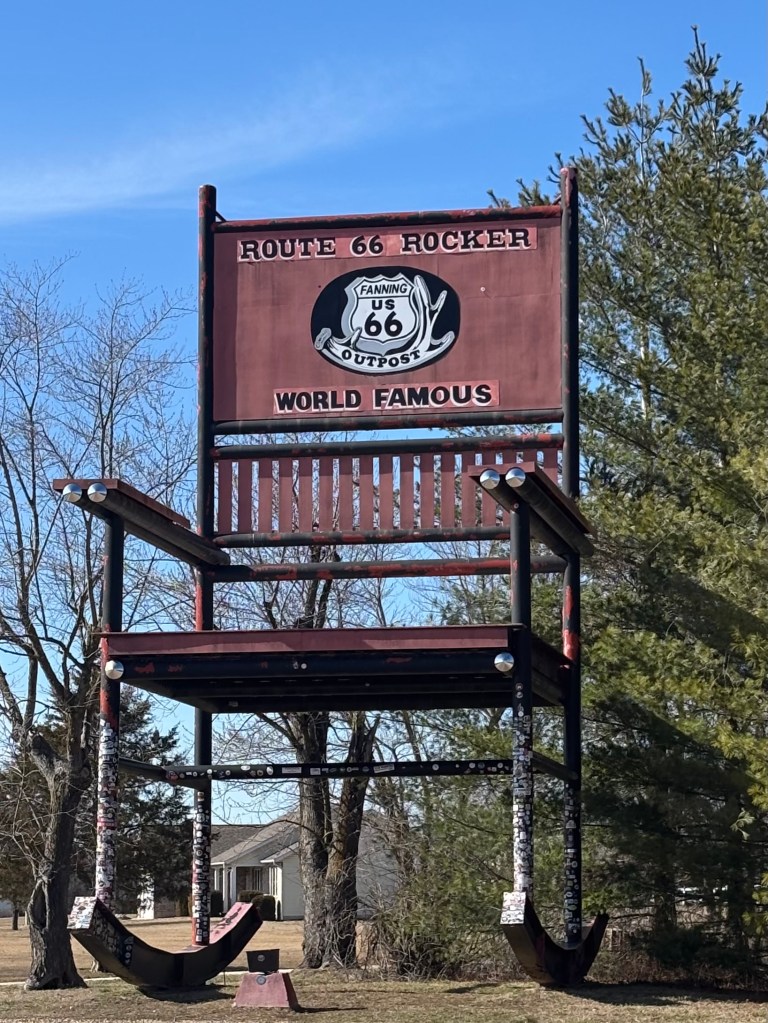
About 5 miles away from the center of Cuba on Rt. 66 wasThe Red Rocker. A giant steel rocking chair, it was built in 2008 to prompt travelers to stop at the Fanning Outpost and General Store next to it. It is big, it is red, and it is covered with stickers as high up as one could reach. Megan, I should have gotten a sticker from you to add to it.
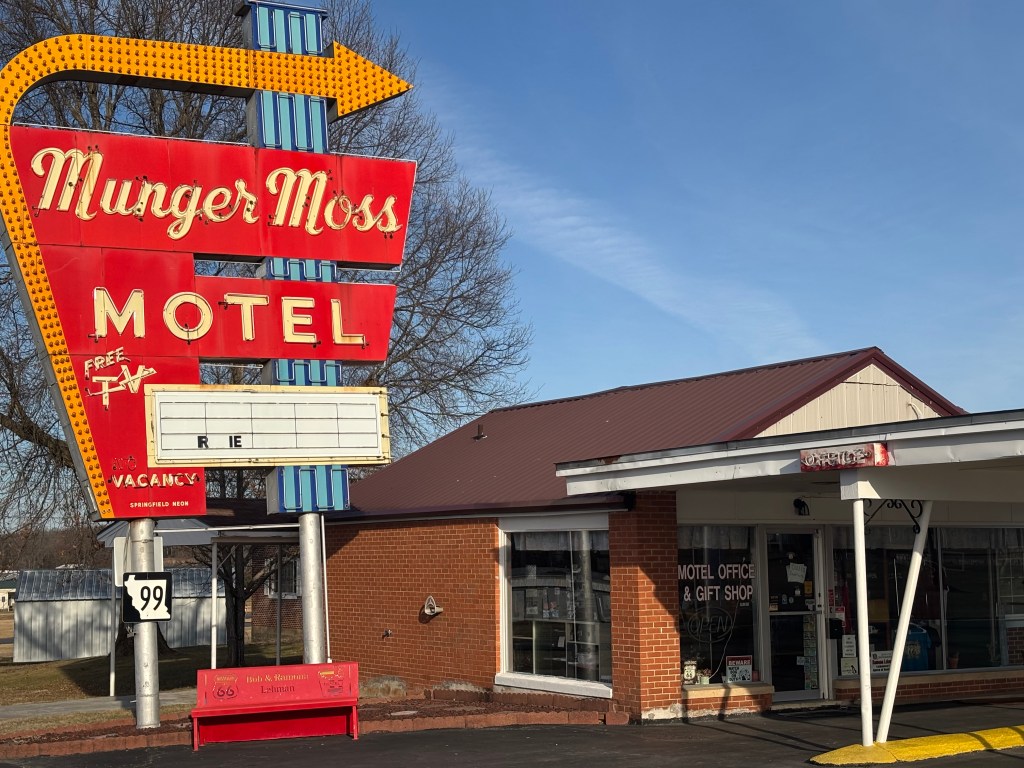
When I was little, my parents used a particular phrase when something was gross or disgusting. It was always said in kind of a low voice and with derision. “Eww, Munger Moss”. I didn’t know where this came from, although I thought it was the name of a diner or bar or something like that. I never really thought about it, it was just part of the family lexicon. I don’t know if my brothers even remember it. As I was reading Route 66 Travel Guide 202 Amazing Places, by Mark Watson, I came upon this sentence: “If you are going to stay one night at a motel this trip, this next location should be it. The Munger Moss motel opened in Lebanon, MO in 1946 during the glory days of Route 66”. A little scream escaped my lips! Munger Moss!! We lived in Ballwin, a suburb of St Louis, when I was between 6-8 years of age so my parents must have seen a sign or even passed the motel at some point. The words Munger Moss sounded so unappealing to my parents, but in reality Nelle Munger and her second husband Emmett Moss were the original owners of the motel. When I told my mom that I had found the origin of Munger Moss and that I was planning on staying there she just cracked up laughing. She said, “Oh, I wish your dad was still alive to hear about this. He was the one who really used that phrase.” I was touched by this. My parents divorced a long time ago and it was lovely for her to remember him fondly. I was so disappointed to find that the current owners of the motel recently died and it has just been purchased by a company in Atlanta. They have promised to keep it going but at the present time it is closed indefinitely.
Needless to say, I did not stay at the Munger Moss Motel. I travelled a further 45 minutes to Springfield where I am staying at the Double Tree. I have made it safely through Day 1. Tomorrow Kansas and Oklahoma.



















 What’s In Between